April 25th, 2010 — Games, Magic
In the quite likely event that you read Top Decks last week, you know that I listed not just Flame Slash but Forked Bolt in the “awesome” at one mana category. This post is going to be a follow up to the Flame Slash post as well as a brief discussion of its one mana twin / competitor / equal and opposite.
First of all, I just wanted to should out to our great FiveWithFlores.com community for some of their additional Flame Slash commentary.
I focused on Malakir Bloodwitch (probably because I tend to think of Naya first… and Burst Lightning was an important component of the World Championship winning deck); but Twinblaze pointed out that Flame Slash is good against Putrid Leech, and Alfrebaut and some others talked about using Flame Slash to help a beatdown deck get past Wall of Omens, or a Red Deck deal with problem creatures like Rhox War Monk (and any Red mages out there know what a serious problem that 3/4 can be).
So what about Forked Bolt?
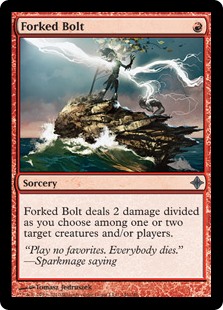
Forked Bolt
Forked Bolt v. Lightning Bolt
First up, it is not strictly true that Lightning Bolt is better than Forked Bolt. I mean it is probably true, but it isn’t even strictly true that Forked Bolt is better than Shock. I mean we all know that Lightning Bolt is the better card due to the twofold “I deal three damage” and “I do those three damage at instant speed” brothers, but we can’t say strictly.
Because of that, I don’t know that Forked Bolt will do much displacement of Lightning Bolt in the first four slots allotted to Red one mana removal spells (don’t forget that Boss Naya and Naya Allies don’t even play four Lightning Bolts main deck). However I feel like Forked Bolt will be a second string main deck card more readily than Flame Slash.
After all, it goes to the head.
Forked Bolt v. Burst Lightning
Forked Bolt v. Burst Lightning makes for an interesting comparison. Burst Lightning — at least before Rise of the Eldrazi — sat on the front line of the second string. There were decks like Grixis Burn that actually appreciated a Burst Lightning and the ability to deal four points of damage. As a Shock variant, Forked Bolt is not going to match that incentive from Burst Lightning.
How about killing little guys?
I have found a lot of tension during the first couple of turns of a game, especially against Vampires or Naya decks… Which one mana spell should I use? Against Vampires you often want to clear out a Vampire Hexmage before playing Ajani Vengeant; against Naya the target is Birds of Paradise or Noble Hierarch. So do you Lightning Bolt or Burst Lightning?
It’s been months and I still have no clue!
Against Vampires you typically want to save Lightning Bolt for Vampire Nighthawk… But sometimes you have to make sure you have ammunition for Vampire Nocturnus (I mean, should the worst happen). Against Naya, you usually want to save Burst Lightning for Knight of the Reliquary (provided you can still deal with it at all, Burst Lightning will often be better than Lightning Bolt) or Woolly Thoctar; on the other hand, the Burst Lightning deck I played for months would often have to respect Great Sable Stag.
While Forked Bolt can’t actually kill a Woolly Thoctar [by itself], it does remove a lot of the tension on the first turn. For example Forked Bolt versus Lightning Bolt is not much of a fight when you are faced with Noble Hierarch, Birds of Paradise, or Vampire Hexmage; you can kill any of those little guys, and send an extra point to the opponent’s head. Perfect!
Subtly, Forked Bolt is a good supplement to Lightning Bolt when you have to kill a larger creature. You can tag team to take down a Woolly Thoctar, say, and still point the last ding ding at the opponent; while that doesn’t make up for the craptastic-ness of blowing a second card on a three drop, paying yourself back a point is nice (or you can snag an X/1 while you’re at it, to more-or-less break even).
Forked Bolt v. Flame Slash
As far as second string single [mana] sorceries go, these two are both awesome… but don’t really compete for the same jobs. They are like Diet Coke and Vitamin Water.
Forked Bolt does something pretty unique; in the past you needed to invest three mana for this effect. And even if it was good (Osyp made Top 8 the first Pro Tour Electrolyze was legal), no one has played it in forever… We just don’t like to deal two damage for three mana even when we get to draw a card. Make no mistake, this card can be a blowout against some draws. You know those games where the Green deck kept two lands and two Elves (or whatever Birds / Druids)? Forked Bolt can Mind Twist them at the same time as manascrewing them on one of these draws.
Plus, Forked Bolt is so much more versatile. You can pick it up and point it (or, as we’ve said a couple of times, point half of it) at the head. That makes it hell off the top.
Flame Slash is different. Flame Slash is surgery. That might be a strange thing to say given what a generally inflexible, brute force (if awesome) card Flame Slash is. But think about it: You want Flame Slash for a specific job. Specific kinds of decks want it, typically out of the sideboard, to get rid of or compete against known — dangerous — quantities.
In the words of the great Tsuyoshi Fujita, “Depends on the metagame.”
I think Flame Slash is unlikely to be a main deck card, but quite likely to be a sideboard Staple.
I think Forked Bolt will be the new second string main deck card, largely replacing Burst Lightning in that role. That is due to the ability to go to the head and the ability to deal with common creatures while still hitting for a little damage (all for so little mana, of course). However depending on how the metagame evolves one might be more common than the other. Alternately the decision might be dictated by what deck is making the decision. For example, I don’t really see my school of Naya decks fighting over little X/1s rather than caring about the much-mentioned Malakir Bloodwitch.
But it would be perfectly reasonable for some Red Decks to go the other way.
LOVE
MIKE
April 22nd, 2010 — Games, Magic
One of my favorite new Rise of the Eldrazi cards is Flame Slash. Here’s why…
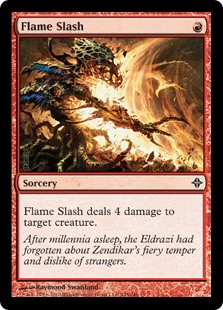
Flame Slash
I don’t think Flame Slash has gotten nearly the respect it deserves.
Is it Lightning Bolt? No.
Is it as good a card as Lightning Bolt? Not really.
Flame Slash is a sorcery rather than an instant. That means you can play it about half as often as Lightning Bolt (even less often if you think about it… You can play Lightning Bolt on your own upkeep, end step, and so forth); Lightning Bolt — long the benchmark for riotous Red — is so much more versatile. It can go to the head (Flame Slash can’t), it can mess up a double block, it can take out a Raging Ravine.
Flame Slash can’t do any of that.
Lightning Bolt is way overpowered. We all know that. Those of you who have been following this blog for a year or more — or me on Twitter or whatever — know that I was skeptical about Lightning bolt really coming back. It is just so overpowered… That, and we were perfectly willing to play Volcanic Hammer in Extended or in Standard Black-based control decks or in ‘Vore or a dozen other places it seemed like a dream world for Lightning Bolt to come back.
Lightning Bolt was the Old Soldier. It wasn’t needed (or at least it didn’t seem needed).
The thing is… Flame Slash is way overpowered, too.
One of the only things that has kept Red removal interesting since, I dunno, Alpha is the fact that it has a high water mark of three; great when a Grixis deck needs to take out a Great Sable Stag… less so when the classic Sligh has to do battle with a Serra Angel.
Modern Standard has its Serra Angel, too; this girl:
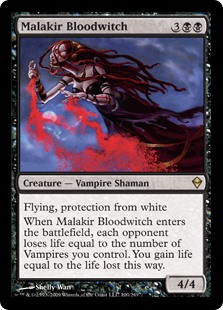
Malakir Bloodwitch
You’ll probably recall that Naya Lightsaber sided a pair of Burst Lightnings. They were there, primarily, for a base-White deck to deal with Malakir Bloodwitch (I had Andre siding Burst Lightning in against Boros Bushwhacker, too, but when they were on the mid-range strat going second, Burst Lightning was a lot less effective).
So how about Flame Slash?
Even worse against Boros Bushwhacker.
But how about Malakir Bloodwitch defense?
Couldn’t be better.
I think that you will find Flame Slash to be one of the best cards in the new set. It is probably not going to be a main deck card. Ironically — in a world with options like Searing Blaze — it might not even get Red Deck sideboard love. But for White or Naya decks (at least those unwilling to invest in a Day of Judgment), I think Flame Slash will become the option of choice for suppressing Malakir Bloodwitch and Woolly Thoctar… Or just another one mana play that can help out against, say, a Noble Hierarch on the first turn.
I don’t think it matters a whole lot that Flame Slash is a sorcery. Yes, it is much worse against a man land, but for the most part, creatures give you a window to deal with them before they start whaling away at your life total (no offense to Vengevine). As such, while Flame Slash is less flexible than the current options… Who cares? You don’t make friends with salad, and you don’t win Pro Tours with flexibility (well, maybe sometimes you do… But forget any times that would conflict with my awesomely pithy claim).
In sum: Flame Slash – awesome.
Go fight win!
LOVE
MIKE
April 11th, 2010 — Games, Magic
Just how good is Rise of the Eldrazi Rare, Eldrazi Temple?
Pretty elfin’ good, we think.

Eldrazi Temple
The first thing I thought when I saw Eldrazi Temple was “Temple of the False God”.
Longtime readers know how YT feels about a Temple of the False God. I played Temple of the False God in my Biorhythm deck, the first deck (to my knowledge) that broke Windbrisk Heights (though I used Naya Rith’s Charm rather than Spectral Procession as my trigger finger), and many other decks that ran cards like Eternal Dragon, like the G/W Control deck that Brian Kibler used to make the Top 8 of US Nationals in 2004.
Temple of the False God was a little greedy. It was not useful, for instance, on turn one. Even as a second land, Temple of the False God can make you scratch your noggin and throw one back… teary-eyed as your regret the non-action on that Eternal Dragon in your close-to-sick opener.
How about Eldrazi Temple?
The name itself hearkens to Temple of the False God… Temple to Temple, as it were.
Provided you can use colorless mana, Eldrazi Temple is good starting on turn one. I had to double-take on the second ability:
T: Add 2 to your mana pool. Spend this mana only to cast colorless Eldrazi spells or activate abilities of colorless Eldrazi.
Can you play a MOTHERLOVIN’ TURN ONE MOTHERLOVIN CUP?
Sadly, Everflowing Chalice is not Eldrazi.
Damn.
So what good is Eldrazi Temple?
Well, you are one mana closer to slamming down that Emrakul, the Aeons Torn. Fifteen mana is like thirty mana when compared to fourteen mana (this is a concept that GHWeiss turned me onto a couple of years back). Think about it: The idea of being “manascrewed” with fourteen lands in play is probably strange, but being manascrewed is really about the absence of your ability to play your spells. Emrakul costs fifteen mana. When you’ve missed drop fifteen a couple of turns in a row, that can start feeling insurmountable.
A core function (and almost the only reason you will add a colorless land like this one to your deck list) of Eldrazi Temple is going to be pulling you to virtual-fourteen, one mana closer to your bombastic Eldrazi boom booms.
Which boom booms?
Gigantors are hawt and all, but I think this one will be the most commonly played of the lot:

All is Dust
All is Dust “only” costs seven mana; with Eldrazi Temple that pulls it down to non-Temple of the False God Akroma’s Vengeance mana. Multiple copies of Eldrazi Temple may have your opponents tearing their hair out.
All is Dust is [generally] more powerful than Akroma’s Vengeance (despite not cycling), in particular because it poops on Gideon Jura or Sarkhan the Mad. On the other hand, the main reason we played an Akroma’s Vengeance-based deck in 2004 was to blow up all the artifact lands (which All is Dust doesn’t do… Not that it matters in 2010).
All is Dust seems — at this point, before I’ve actually played any Rise of the Eldrazi — as the most “splash-able” of the big Eldrazi spells. Most of the other cards seem like the kind of stuff you will have to play Summoning Trap and / or a ton of specialized mana to play; but All is Dust will see play in regular control decks as catch-all Wrath redundancy or Planeswalker suppression.
Eldrazi Temple, when casting Emrakul, will feel like a free fifteen. With All is Dust, it will play out like twelve mana when you are under pressure. I know that it won’t be exactly like those gigantic amounts of mana when you look at the board and lands tapped, but when cards that cost 10-11 mana are competing with Blightning and Countersquall, the value of mana acceleration this good — and this opportunity cost-less — can’t be exaggerated.
Long story short – Staple
Go get your playset. If you have any designs on fatty boom booms over the next two years, you will probably want four.
LOVE
MIKE
Currently Reading: Justice Society of America: Thy Kingdom Come, Part 3
April 9th, 2010 — Games, Magic
Concerning:
Rise of the Eldrazi Mythic Rare; Emrakul, the Aeons Torn!
(So this is what you get for fifteen mana).
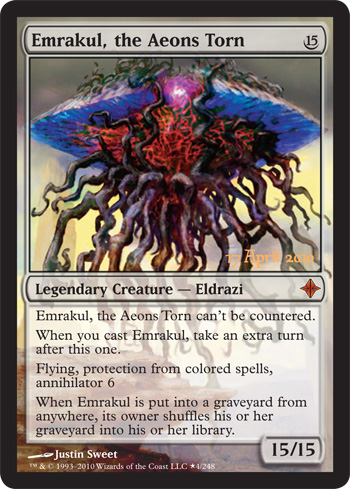
Emrakul, the Aeons Torn
Is this card very good?
Last week we talked about not having a great frame of reference for Ulamog, the Infinite Gyre at 11 mana; the fact is, Ulamog is more-or-less on-par with Darksteel Colossus (which was a tournament Staple as a one-of in Block, Standard, and Extended Tooth and Nail decks, and Vintage Tinker decks). Both Ulamog and Darksteel Colossus cost 11 mana for huge creatures. 11/11 is bigger than 10/10 but whatever… Two hits from either will smite many a mage. Both creatures are indestructible, and both creatures feature a “Gaea’s Blessing” clause.
As I said, Darksteel Colossus was a tournament Staple, and Ulamog is probably the stronger despite being marginally smaller. Ulamog is a Desert Twister; though he can be countered, his Vindicate effect can’t really be. And while Ulamog hasn’t got Trample, Annihilator 4 is a fair trade-off. After all… How much is the opponent going to have lying around to block with?
But what about the card at hand — Ulamog’s co-Eldrazi conspirator; Emrakul, the Aeons Torn?
If we have relatively little framework for 11 mana biggies, what about fifteen-casters?
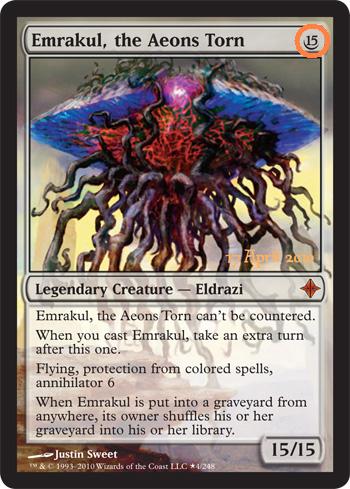
The second coming of Draco!
In the case of Emrakul, I think the mana cost may be an advantage. Maybe not in the hard-casting business, but don’t forget that we’ve seen hefty cards like this one prominently featured in tournament competitive decks in the past. To wit, Draco in the Erratic Explosion strategy (more on this later).
Given the availability of an Erratic Explosion analogue, I would rate Emrakul, the Aeons Torn at Role Player – High at a minimum.
But in addition to being one of raw-largest creatures we have ever seen, Emrakul, the Aeons Torn is covered in text.
Emrakul, the Aeons Torn is particularly good against permission spells. I think that that particular wing of Magic: The Gathering may be operating at an all time nadir due to the incentive to playing gigantic Eldrazi plus the presence of Summoning Trap. So while many gigantic creatures will theoretically be vulnerable to Essence Scatter or whatever, you really don’t want to put your opponent in a position where he can miss Summoning Trap into Emrakul, the Aeons Torn.
Both of Emrakul’s first two lines of text are relevant against permission. Obviously it can’t be countered (holy relevance), but the second line subtly overcomes an Overrule as well. Emrakul doesn’t have to resolve or hit the ‘field. It’s enough to cast it in order to Time Walk.

Emrakul, the Aeons Torn is very effective against permission.
Emrakul has even more text.
Flying – He can block attackers that might otherwise be able to race, viz. Baneslayer Angel.
Protection from Colored Spells – Interestingly other Eldrazi can interact with Emrakul. Five Searing Blazes or whatever, though? Even though they only cost a paltry ten mana in aggregate… Not so much.
Annihilator 6 – Ka-pow.

If there is one thing you can say about Emrakul, the Aeons Torn, it’s that he’s covered in rules text.
Also, you can’t be decked.

Also, you can’t be decked.
Okay, maybe you can be decked, but it’s a lot more difficult with even one Emrakul, the Aeons Torn in your deck than without.
The “Dakrsteel Colossus” Gaea’s Blessing wannabe ability probably helps to control the Eldrazi power level. The concern would be reanimation for mana savings.
Emrakul, the Aeons torn will be plenty good even without Summoning Trap shenanigans.
Snap Judgment Rating – Staple
‘LOVE
MIKE
April 8th, 2010 — Decks, Games, Magic, Marketing
Concerning:
- Jamie Wakefield
- Student of Warfare
- The Spanish Inquisition
Before we get in to Magic: The Gathering blogging, I just wanted to throw something out there:
Jamie Wakefied has just come out with a new book. As far as I can tell, this book is not about Magic: The Gathering. I am going to order it… any longtime fans of Jamie (and I’m sure that many of you hold yourselves in that group) should probably do the same.
For the love.
This is an Affiliate link to Amazon.com.
If you order, I will probably make one trillion dollars. Or maybe like one dollar.
Greedy capitalists.
Okay, now for the Magic: The Gathering part.
Student of Warfare:
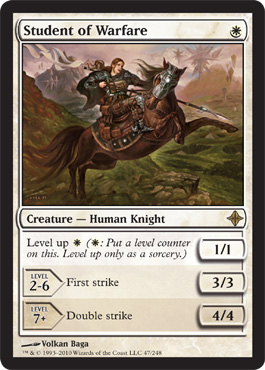
Multiple people, including Jeroen Remie via Twitter and Slov01 in the comments of the last post pointed out that Student of Warfare is much the 3/3 for three mana as Transcendent Master.
I was actually planning to write about Student of Warfare anyway… But I hadn’t thought of it in that way.
The reason is that, even if it can be thought of as a 3/3 for three mana, it isn’t. It is much, much, better.
The first reason why Student of Warfare is better than a “regular” Gnarled Mass is that it costs one, not three, as a base. This lets you put a down payment on the card on turn one, then spend the next two on turn two for three damage on the second turn (you know, a turn before you could even playTranscendent Master.
Its one-ness is very powerful with one of my three favorite [Standard] creatures, Ranger of Eos.
Student of Warfare is like the white side of Figure of Destiny in the same way that Kargan Dragonlord represents a Red analogue. In my opinion, Student of Warfare seems like the stronger card because its one mana-ness lets it lace up with Antoine Ruel like Figure of Destiny did in Boat Brew.
The second reason why Student of Warfare is much better than a Gnarled Mass — not that being better than a Watchwolf on the second turn without going into a second color isn’t good enough — is that it isn’t just a 3/3; it’s a 3/3 first strike… Kind of like a White Knight grafted onto a Hand of Honor (you know, whiteout the racism).
Getting to Level Seven is quite realistic. It will be awesome when it is awesome. We probably don’t have to spend a whole lot of time on the “ultimate” to this leveler.
Snap Judgment Rating – Staple
More Spanish Inquisition
I know “current” Standard is medium-irrelevant just now, but I have been having a lot of fun playing. This is what I have been playing most; I am very happy with it actually:
4 Armillary Sphere
4 Everflowing Chalice
1 Obelisk of Alara
4 Ajani Vengeant
4 Burst Lightning
4 Chandra Nalaar
4 Lightning Bolt
4 Day of Judgment
2 Elspeth, Knight-Errant
3 Path to Exile
12 Mountain
4 Naya Panorama
2 Plains
4 Valakut, the Molten Pinnacle
sb:
1 Obelisk of Alara
4 Goblin Assault
4 Celestial Purge
1 Elspeth, Knight-Errant
4 Oblivion Ring
1 Path to Exile
The distinguishing thing about this version is still the Goblin Assault set after sideboarding. I really like those: They have been great against control, in particular the relatively popular Jace, the Mind Sculptor decks.
Main deck the main difference between this and the pre-Worldwake version is the addition of Motherlovin Cup aka Everlasting Chalice. The Chalice lets this deck play third turn Ajani Vengeant, Day of Judgment, or sometimes Elspeth, Knight-Errant.
If there is one card (or kind of card) I would like to play (or rather add), it is something like Earthquake or Martial Coup. Martial Coup would be great in particular with Motherlovin Cup… Not sure what to cut right now. I have sided every card in the ‘board in the last 24 hours, with Oblivion Ring a necessary evil due to the many, many Planeswalkers that are now played even in Standard aggressive decks.
Anyway, that’s it for today. Pretty exciting news for fans of me, Billy Moreno, and Paul Jordan that we will unveil relatively soon 🙂
/anticipation
LOVE
MIKE
April 7th, 2010 — Games, Magic
Transcendent Master: an affront to everything that is good and true.
Once upon a time there was a superb Constructed format. Some gripers complained that it was overly dominated by Umezawa’s Jitte, but it wasn’t. Teddy Card Game actually wrote an article claiming that Gifts Ungiven variants were more dominating in this format than Affinity decks had been [in Mirrodin Block Constructed] a year prior. Inconceivable!
Anyway… a superb Constructed format, trust me.
There was a controlling combo deck in Gifts Ungiven… all positional advantage and card drawing that could lock the game with infinite defense or ending the game with a stack of Kokushos.
There was a control deck. Mono-Blue control with All-Star threats like Meloku and Keiga. This deck could draw up with Jushi Apprentice and hold off the Gifts Ungiven deck, essentially forever.
And there were beatdown decks. Mono-Black. Mono-White. Some even tried for Mono-Red.
The format had diversity in spades, but it was laced together by Umezawa’s Jitte. Jitte was a glue that made White Weenie playable… saw little play in Blue, and was irrelevant to Gifts.
As you most likely know if you are a longtime reader, I was able to solve that format with two weeks to go. The Critical Mass deck, playing a “critical” set of Gnarled Masses was the ultimate solution to the format. It had the counterspells of Mono-Blue, but vastly superior tempo; Sakura-Tribe Elder in game one, and a “surprise!” set of Jushi Apprentices and Threads of Disloyalty (for their Jushi Apprentices) after boards.
Its counterspells allowed Critical Mass to dominate Gifts Ungiven. When the Apprentices came in after sideboarding… Honestly, I don’t think I ever lost a single sideboarded game in testing the matchup was so strong.
The “critical”-ness of the Gnarled Masses was mostly for White Weenie. White Weenie had 2/2 creatures at every drop.
- Isamaru, Hound of Konda
- Hand of Honor and Samurai of the Pale Curtain
- Kitsune Blademaster
- Hokori, Dust Drinker
The Critical Mass deck had by far the superior late game. Umezawa’s Jittes were a wash; U/G arguably had the advantage because Kodama’s Reach and Sakura-Tribe Elder could help thin the deck and increase the instances of their appearing. The end game was a murder of Legendary creatures… Kodama of the North Tree in addition to the Blue beaters.
The problem was getting there.
If the White Weenie deck had a tempo advantage going into turn four, ka-pow! Hokori, Dust Drinker!
U/G’s spells were very expensive, so the Winter Orb-like Hokori could turn the deck to molasses. The 2/2s would hammer in until it was over.
Critical Mass’s solution took away the tempo advantage going into turn four.
Was Gnarled Mass better than the White Weenie equivalents?
Absolutely not!
But once they were both in play, the cards could be more-or-less the same (with the Green one just costing more). A board at parity would not necessarily be a good place for White Weenie to tap out four with a walking Winter Orb.
Time.
Time TIME TIME.
That was what U/G needed — even just a couple of turns — to get its Legends online.
At the end of the day, Gnarled Mass — a mere 3/3 for three mana — got the job done. I won the last PTQ in NYC, and a week later Gerard Fabiano made Top 8 of the last Grand Prix with Critical Mass.
So why is Transcendent Master the enemy of all that is good?
Simple.
I just don’t want to see White Weenie with a 3/3 for three 🙂
How un-special is that? How un-special does that make Gnarled Mass?
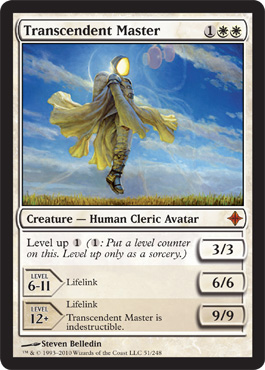
The fact of the matter is that Transcendent Master is not just a 3/3 for three mana.
At Level 6, it is a medium-gigantic 6/6 with Lifelink.
Is that a good deal?
We are talking about nine mana for a 6/6 Lifelink… You would basically never play that at retail, but the 3/3 for three-ness of the card at the baseline softens the impact of the absolute cost. A great deal? No. But serviceable due to the fact that you can tap out on turn three, cross your fingers, and sometimes have an impressive 6/6 on turn five.
How about the final version?
Fifteen mana for a 9/9 indestructible Lifelink? Unlike on Figure of Destiny update Kargan Dragonlord, the math does not become more favorable as time progresses. Again, not a tremendous deal… But the core-3/3 for three pat makes Transcendent Master good enough to ruin without help. The biggest mode — and it is pretty big let’s be honest — might not be the selling point, but it is still a useful feature that will come up sometimes.
You know, to help bury all memory of truth, goodness, and light.
Snap Judgment Rating – Role Player
LOVE
MIKE
April 3rd, 2010 — Games, Magic, Reviews
A new card that lots of my Twitter followers have been asking me to write about is Gideon Jura:
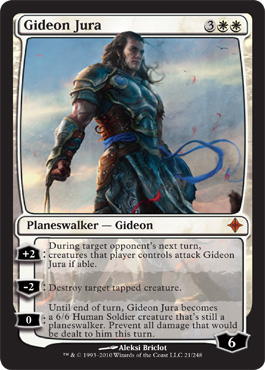
Gideon is an interesting and potentially powerful card; not one that I would necessarily have identified on my lonesome. Apparently people think it’s going to be a chase rare (and by “chase rare” you probably can’t miss the fact that Gideon Jura is actually Mythic Rare).
Gideon Jura costs five mana, specifically 3WW. It costs exactly the same amount as, you know, Baneslayer Angel.
So which is better?
Baneslayer Angel.
Baneslayer Angel is better than Gideon Jura. Baneslayer Angel will win games that no other card would be able to win. We played Baneslayer Angel in the mono-Cascade (you know, Black “Baneslayer”) deck because that deck’s mana base put us behind against Anathemancer; one or two hits from a Baneslayer Angel and you don’t really have to worry about Anathemancer any more. Baneslayer Angel blocks. She blocks so well that often she doesn’t have to block. You lay her out there and the bad guys are terrified of attacking. Baneslayer Angel blocks so well that when she motherlovin’ attacks, the five life you get back is basically like she hung back to block.
So Baneslayer Angel is better — given my snap judgment superficial never-played-a-Gideon-Jura-yet assessment — than Gideon Jura, card-to-card.
So why are we even having this discussion?
Just because Gideon Jura isn’t as good a card as the best large creature in the history of Magic doesn’t mean that he won’t be a significant and useful potential tool. In fact, Gideon Jura will be more applicable to many strategies than Baneslayer Angel was, or is. For example, creature-poor decks often lose their Baneslayer Angels immediately. Lay her out there… and she’s dead. Gideon Jura wouldn’t be immediately dead. You can’t Terminate a Gideon Jura; ergo you won’t be sitting there with a stray Terminate in your hand when Gideon Jura shows up, poised to blow up the new Planeswalker.
We know Baneslayer Angel is worth tapping out for. Is Gideon Jura?
I think it depends.
It depends on what you want to do, and what your deck wants to do, and how you want to hold hands and go about doing what you plan on doing. For example, a deck like Naya Lightsaber can play Noble Hierarch, Great Sable Stag, Bloodbraid Elf, Baneslayer Angel… threat, threat, threat; pressure, pressure, pressure. Baneslayer Angel is great there in a way that Gideon Jura might not necessarily be.
A control deck can play block, tempo, counter, bluff, Baneslayer. If she lives, great. If she dies, well… You were probably going to play Day of Judgment anyway. Baneslayer Angel is worthwhile there.
This is a spot where Gideon Jura might actually be better. You can counter, kill creatures, play your Planeswalkers, Day of Judgment with no loss of card advantage, and then clean up with Gideon Jura. He’s pretty strong in the sense that a White control deck can sweep the board and then go Mishra’s Factory with a 6/6, essentially unopposed. In this sense, Gideon Jura is a fine finisher.
But for all his lack of “ultimate” Planeswalker abilities, Gideon has three… It might be worth looking at all of them:
- [+2] This ability seems applicable in [at least] three broad ways: 1) “Delayed Blast Falter” … a White Weenie deck (or whatever) can make all the opponent’s creatures attack Gideon Jura, leaving him (mostly) open for a return Alpha Strike, 2) “Turbo Fog” … Gideon Jura could fit into this kind of a strategy, both as an additional White Fog-proxy (and ultimately an alternate kill condition), 3) Boosting Gideon’s loyalty … Because sometimes you have to.
- [-2] Gideon Jura can go Nekrataal immediately upon hitting the battlefield. The opponent just attacked? You can spring the slaughter and have four loyalty left.
- [0] Probably best in a true control deck, but serviceable in any deck that plays Gideon.
Gideon Jura is a potential one-card combo. You can play him, activate the [+2] and win almost on the spot. If you have some decent blockers, one or two Gideon Jura-directed suicide runs will make for some kind of a no-limit swing. You can actually sit there activating [+2], forcing the opponent to run into a Celestial Colonnade or whatever, until he decides he is tired of banging his head against the wall and throwing his creatures into the graveyard.
I think Gideon might be a nice component in a Planeswalker-themed control or board control deck. He has lots of colorless mana costs, and should therefore hang it nice and loose with Everflowing Chalice. As a fourth or fifth turn follow up, Gideon can play big brother to Jace, the Mind Sculptor. Just keeping attackers off of Jace will be worthwhile a fair amount of the time.
As already implied, Gideon Jura is a solid potential finisher in a true control deck. He does everything you need him to do. You need to kill creatures? Gideon kills creatures. You need to keep damage off of your own neck? Gideon might just play Baneslayer Angel, heroically, for a turn or two. You need to win the game? Gideon can handle that action, too.
If there were a rating between Role Player and Staple, that’s where I would position Gideon Jura; but there isn’t.
Snap Judgment Rating – Staple
LOVE
MIKE
April 2nd, 2010 — Games, Magic
Concerning:
Gelatinous Genesis ∙ Pyknite (barely) ∙ Grizzly Fate (essentially)
Simic Sky Swallower (err…) ∙ Iona, Shield of Emeria (stretching on this one) ∙ Ulamog, the Infinite Gyre (stretching infinite, actually)
… and Gelatinous Genesis
Or:
“At what point is a Gelatinous Genesis good?”
I find Gelatinous Genesis a genuinely interesting card to think about.
No, really.
Cards like this one are intriguing. The mana cost is considered; the potential upside of the card, considerable.
Should we instantly dismiss it?
Or: Is it awesome?
A card like this one has different value at different mana costs.
A simple comparison would be the card Drain Life.
A little over a year ago I wrote about “Magic Writing That Can Change Your Life”; in particular a PTQ report by BIll Hodack that changed my life. Bill played a B/R Necropotence deck that ran both Lightning Bolt and Drain Life (one Incinerate in the sideboard). In a deck that can easily access both sorts of mana (and in particular a deck that plays the card basic Mountain), Lightning Bolt is the superior card on bases of speed, flexibility, mana efficiency, and almost every other reasonable metric. Drain Life is superior only when you have an excess of mana. Like Gelatinous Genesis, it is increasingly useful as you have an increasing amount of mana; there is a minimum threshold where Drain Life becomes useful (the line that has stuck with me for 14+ years is “I wanted low casting cost spells. Drain Lifes become useful[l] at about 5 mana[.]” This simple statement helped create a framework in my mind that I have carried with me as a deck designer, player, and so on for all this time.
The practical implication is “At about four mana, you can kill a Black Knight and get something out of it… It just gets better after that.”
Gelatinous Genesis, I think, is going to be like that: It should become useful at a certain mana point; after that it will be very good. No one is really writing home for a four mana, Black Knight-killing, Drain Life; we play it for the dramatic swings it can create later in the game… But without a measuring stick, some kind of basis for evaluation at all, we have less of a rudder to help steer the strategy of our “ship” … and we can dismiss a card that is, quite frankly and by most evaluation criteria, significantly inferior to a Lightning Bolt.
So is Gelatinous Genesis awesome, or even super awesome?
At this point, I am not sure. It compares interestingly (and even favorably) to other historically playable cards at similar mana points. Let’s discover them!
Gelatinous Genesis has no effect at one mana and can’t be played for two mana. Let’s begin at three mana.
THREE
At three mana, Gelatinous Genesis puts one 1/1 creature onto the battlefield.
This is most like a Pyknite (without the cantrip-ness).
Originally I was thinking of a Wood Elves (without the attached Rampant Growth)… But I have qualified for the Pro Tour with Wood Elves, and the main reason we play Wood Elves is for the Rampant Growth-ness, not the 1/1-ness, so that would be a horrible insult to Wood Elves. But Pyknite… At three mana this card is just a terrible Pyknite.
And no one credible ever played with Pyknite.
FIVE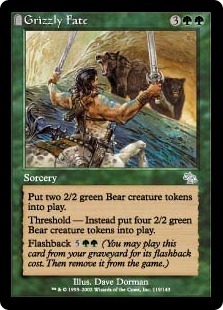
At five mana Gelatinous Genesis puts two 2/2 creatures onto the battlefield; it generates a net of one permanent simultaneous with four power. It is not so different from an Indrik Stomphowler.
There are actually lots of things that it is comparable to at this mana cost…
Turntimber Ranger – Gelatinous Genesis, were it only a five mana spell, would be far worse.
Bestial Menace – Ditto; Bestial Menace generates both more permanents and more power.
Grizzly Fate – Gelatinous Genesis on five is exactly an unenhanced Grizzly Fate. However Grizzy Fate, which was a much sought after bomb had both Flashback and Threshold. Was it much, much better than a five mana Gelatinous Genesis? Certainly! … But I think we might be hitting our Bill Hodack minimum usefulness threshold. Bill didn’t play Drain Life to kill Black Knights and we won’t be playing Gelatinous Genesis as a poor man’s Grizzly Fate. But at this point we might have a card — especially as it nets a “card” — we have a not-totally embarassing play, especially if we are going to consider chaining Genesis into Genesis.
SEVEN
At seven mana, Gelatinous Genesis produces three 3/3 creatures, or nine total power.
In a sense this is like a Terastodon, which produces three 3/3 creatures… But also not like a Terastodon at all (it is seven mana versus eight mana, the controlling of the 3/3 creatures is probably much different, no one becomes immediately manascrewed, there is another nine power in the mix); so I would put it much closer to a Simic Sky Swallower.
Why a Simic Sky Swallower?
They are both non-automatic, but playable sevens.
I remember the first time I held a Simic Sky Swallower in my hands. It was the first time we drafted Dissension at Jonny Draft. My deck had either one or two copies of this gigantic seven, two Experiment Kraaj, and five Coiling Oracles. I managed a 2-1.
The more memorable thing was thinking about the Simic Sky Swallower. We had very little frame of reference for seven mana creatures in Constructed. It seemed immediately Constructed playable to me, but I also had a healty measure of skepticism. This is how Simic Sky Swallower ended up, you will probably recall. Played in decks with an excess of mana (non-Staple in UrzaTron decks, not played even in some with Simic Signet), generally but not always played in Team Constructed, not universally played; not fast enough for many strategies.
So which is better?
If a deck is willing to muster seven for a threat, they can be held one against another. Gelatinous Genesis, overall, is the more flexible card. As a seven, strictly, it is sometimes better and sometimes worse than Simic Sky Swallower. This is the first mana point where we can really say that. It is much “bigger” than Simic Sky Swallower, and generates “card advantage” by itself. A Wrath of God (or the equivalent) is about equally good against both threats. Attacking into a swarm, Gelatinous Genesis is often superior. Against a specific kind of threat (Firemane Angel being an important consideration when Simic Sky Swallower was current), Simic Sky Swallower is much better: It could hold off Firemane Angels or attack into one; Gelatinous Genesis [on seven] is much less effective against Firemane Angels (though I don’t really see that being an issue at present).
Three or four years later, we still have relatively little data about how and when sevens are playable. However if they are / would be (and consider there are or were times when we would invest in threats that were “just” sevens), I think we can say at this point that Gelatinous Genesis starts getting “good”. It is the first point where power exceeds mana, at least.
NINE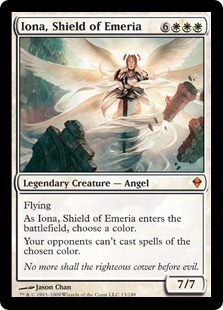
A nine mana Gelatinous Genesis produces sixteen power across four permanents.
The closes point of reference is Iona, Shield of Emeria.
Why do we choose Iona?
If we have little data on sevens, we have even less on nines. However Iona is a nine that is both current and played; so we can ask questions like “When, if ever, is Gelatinous Genesis better than Iona, Shield of Emeria?”
You can’t really compare them in Extended, when Iona is played on the second turn in lockdown situations (I would also hazard that Gelatinous Genesis will never be played in large numbers in Extended); however we can talk about the two cards “playing fair” in Standard. There are multiple decks that will play Iona for retail (mono-White, U/W), and some that even try to cheat out Iona, Shield of Emeria as a “five mana spell” (Solar Flare).
When is Iona, Shield of Emeria better than Gelatinous Genesis [on nine]? I think that the kinds of decks that play Iona give us a good indication of when it would be better. Iona is better when you can play her over and over, relentlessly, as in a deck with Emeria, the Sky Ruin. It might also be better when you are a controlling counterspell deck that can use it to cut off a large portion of the opponent’s game with the objective of locking down Stage Three.
I would argue, on counterpoint, that a nine mana Gelatinous Genesis would be better in most other situations, most specifically in a Green deck that has nine mana to spend. If you aren’t specifically playing to lock down an opponent’s game, Iona isn’t that great. Big girl, will probably win… But what do you think you are getting for nine mana? However, think of the times you can lose with Iona in play: “You are getting swarmed” is first on the list. Four 4/4s are better at “not getting swarmed” than one gigantic Mythic, no?
It’s not clear that a gigantic Genesis is better than Iona, Shield of Emeria… But it’s also not clear that a [fairly played] Iona is better than this increasingly flexible sorcery, at this stage.
ELEVEN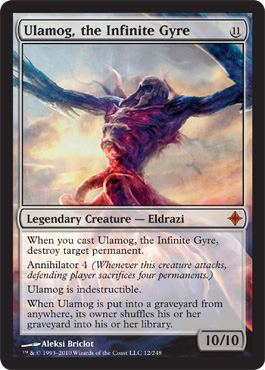
An eleven mana Gelatinous Genesis will give you twenty-five power across five 5/5 creatures.
We have essentially no frame of reference for threats at this mana level — before Rise of the Eldrazi that is — so the closest thing I can compare it to is Ulamog, the Infinite Gyre.
Why Ulamog, the Infinite Gyre?
It costs the same?
It is almost silly to compare the two effects head to head. Twenty-five power, unchecked, is death. I can’t imagine that facing down Ulamog, the Infinite Gyre, with its Nekrataal-come-Darksteel Colossus frame is much easier to beat; not with Annihilator 4. Either one should put you in a commanding position; Gelatinous Genesis being superior in most non-Haste cases due to its resistance to Path to Exile.
Yet there are certain implications to it costing the same (and the presence of other very expensive Eldrazi); the most important, of course, is the presumption that these cards are playable. Ulamog, the Infinite Gyre is Mythic. Presumably it is the one-Eldrazi wow factor. There are so many cards that are so flashy and so expensive I have to believe that we are entering a universe where at least some decks will have the resources to produce twenty-five power across five 5/5 “little” guys.
Snap Judgment Rating: Role Player
LOVE
MIKE
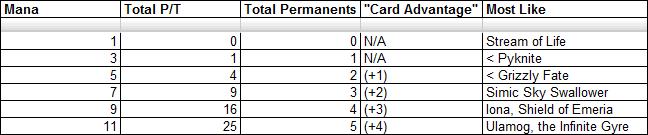
BONUS: The Gelatinous Genesis Quick-Reference Chart
March 31st, 2010 — Games, Magic
Concerning:
Sarkhan the Mad ∙ Jund ∙ Rise of the Eldrazi ∙ Sprouting Thrinax combinations ∙
Bloodbraid Elf (as usual) ∙ WHAT THE HELL HAPPENED? ∙ … and Sarkhan the Mad
Short story:
Basically I was super busy at work.
So I didn’t update in about two weeks.
Then my computer network blew up, which resulted in my not having any MTGO for like a month. Net net – Little or no Magic, resulting in little or nothing to say.
Will we find out what the right play around that Celestial Colonnade is? Soon, I promise (kind of). But for now… A few words on this chap:
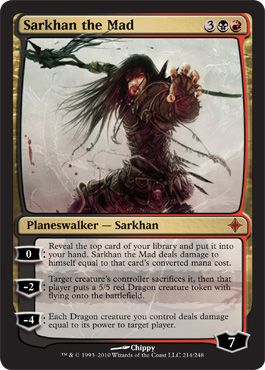
Sarkhan the Mad!
So… A Planeswalker with neither a (+) ability nor an “ultimate” ability. Weird! Crazy! Dare we say “mad” … ? Well, WotC did, so who are we to disagree?
Brian Kowal and others on Twitter have been quite excited (mad even) over the potential on Sarkhan. What gives?
I think the most interesting abilities are the latter two, the (-2) “Target creatures’s controller sacrifices it, then that player puts a 5/5 red Dragon creature token with flying onto the battlefield[.]” one in particular.
Consider:
- Turn three: Sprouting Thrinax.
- Turn four: Whatever good / better / busted turn four you plan to run out there. It can be a Bloodbraid Elf (pretty good), or a Blightning + a tapped land, a Garruk Wildspeaker… Whatever (another Sprouting Thrinax even). You have a damn Sprouting Thrinax in play.
- Turn five: This is where it gets more interesting. You can swing with your Sprouting Thrinax. Now run out Sarkhan the Mad. You can run the (-2) to blow up your Thrinax, and net three blockers (what opponents typically want to avoid giving you), and you get a 5/5 Dragon. He is back on D, along with the other three Saprolings.
PRO TIP:
At this point I think most opponents are going to have to be very wary of Sarkhan the Mad. Because turn six can be mad about you if you grok. If possible, I would say get Sarkhan the Mad below four loyalty, even if you have to use a Lightning Bolt or whatever.
Why?
Otherwise you might be dead on board.
Especially now that Jund decks play like 27+ mana sources you can easily be facing down Broodmate Dragon. That is bad enough, but remember, there is already a 5/5 on the board. If you let Sarkhan the Mad get all mad at you… that is 13 to target player!
This play might not be lethal by its lonesome, but you can still be facing five in the sky from the non-summoning sick Dragon, plus sundry attacks from Saprolings various; if the turn four play was like Bloodbraid Elf + Blightning, that would probably have made the (-4) lethal. Or if it was Garruk Wildspeaker, then the preexisting 5/5 Dragon might have trample.
There are all kinds of, you know, mad things that can ruin your game come turn six.
The (0) ability is whatever, gravy… Relevant a lot of the time, but not strategic in the same way the (-2) ability in particular is. But hey, five mana to draw a card, why don’t ya?
Snap Judgment Rating: Role Player (high); possibly Staple in Jund
LOVE
MIKE
Currently Reading: The Night Watch (Watch, Book 1)