While I was doing research for another article I hit upon what, at the time, seemed like an unusual deck list. It was a hybrid beatdown deck featuring basically every card that I already like to play… Kitchen Finks (basically my favorite), Sakura-Tribe Elder (still my favorite despite what M10 did to the old boy), and Umezawa’s Jitte. I could forgive the Tarmogoyfs and so on because the deck also played the Punishing Fire + Grove of the Burnwillows combination that I so admired from Brian Kibler’s Pro Tour Austin-winning deck list.
But the coolest part?
It was also a combo deck!
So you have this angle of just good Green creatures… Literally the kind of creatures I probably like to play too much (see “The Greenest Mage of All” posts here and here over at Top8Magic), but then the deck also has a full-on Scapeshift kill!
I was used to seeing Scapeshift out of Ceta-colored decks, Blue all the way to their Cryptic Commands… but this could work, too.
4 Grove of the Burnwillows
6 Snow-Covered Forest
6 Snow-Covered Mountain
1 Snow-Covered Swamp
4 Stomping Ground
2 Treetop Village
2 Valakut, the Molten Pinnacle
This main deck is basically the default “what everyone is playing” for this archetype with no modifications from YT. The sideboard is informed from looking at a bunch of different deck lists and not resorting (for once) to Akroma, Angel of Fury.
You probably get how the main deck works already if you are reading this blog; in fact, you are probably ahead of me because I just saw this deck 🙂
… But the sideboard probably takes some explanation.
You can play a sideboard like this one a couple of different ways, including staying straight Gruul instead of going Jund. I decided to go Jund because Extirpate is just that damn good, in particular against Thopter Foundry combo decks. Ancient Grudge is about my favorite Extended card ever… So how could it not join the party? I’ve already got Sakura-Tribe Elder and Kitchen Finks, after all.
Anyway first impression of this strategy was “how can this deck compete with other combo decks,” followed by “I really don’t see how I can compete with a deck featuring Baneslayer Angel” … But after having played it for a while, I really like the feel of the deck.
My first outing was against a Living End combo deck.
He got all kinds of cycling and so forth, but my deck was a bit shy for threats. Anyway he cycled Street Wraith a couple of times but otherwise evoked Shriekmaw to kill my Tarmogoyf… stuff like that. Fulminator Mage kept me off of seven for a while, but he just didn’t kill me. I played two or three copies of Search for Tomorrow and a pair of Sakura-Tribe Elders (the second one was actually Samwise Gamgee at the end of The Two Towers, Umezawa’s Jitte in one slithery hand, ruling the board.
Oh well, you can be 7/7 some other day. What I really want is a basic Swamp.
Kill ya. [Before you kill me, you filthy combo deck!]
I wouldn’t have needed his Street Wraiths because of my Sakura-Tribe Elder beatdown and some Punishing Fire action, but I can’t complain.
Game Two he just drew no Cascade spells. He cycled and cycled and I just played Thought Hemmorhage for Livinig End and he was pretty kold.
I played against a couple of men running the Lightning Bolt Deck… Not surprising, especially for online.
The frustrating part was being essentially unable to sideboard despite losing Game One in the first outing.
I just hit my Kitchen Finks on turn three and it was really easy to win.
I also played against some “rogue” (ahem) type decks and another combo deck (though which kind escapes me). All dubyas so far.
I do think this deck lacks a little bit of “I win” flexibility (for instance, it has no way to disrupt the fastest Dark Depths draw), but all-in-all I was very pleased and I think I will sleeve up a version of this for my next Extended PTQ, provided I play in another one.
Firestarter:
What do you guys think about Dead // Gone? It seems like maybe I should sideboard that; just another card that you can bring in against beatdown (though this deck seems generally advantaged), but also the three mana side can fight 20/20 Coldsnap guys better than, you know, the nothing we have right now.
Literally a picture of consistency… or in this case, inconsistency:
I have gotten a lot of comments about this screen shot.
What the heck is going on?
Why did I put that in the blog post?
Huh?
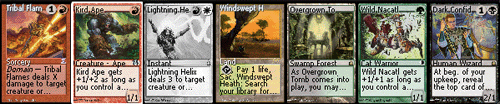
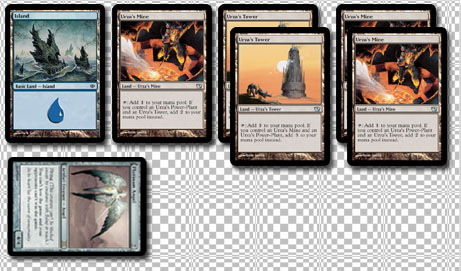
Imagine if you will that this was your hand and board, instead:
You are attacking with a Firebrand Ranger.
You have three basic Mountains in play.
Your hand is two basic Mountains and an, um… Tribal Flames (there is no burn spell bad enough to use a stand-in).
Your opponent is at 19.
Really?
How bad is it?
You would be hard pressed to win against a well-built sealed deck with those tools only.
And while “cards in hand” have a non-zero value if for no other reason than you can bluff, that is what was depicted in the previous post’s screen shot.
So why am I bringing this up? Surely there is something productive to talk about beyond “Blood Moon is good against Zoo.” And there is! Zoo is just a perfect example.
I told Josh today that I took out one of the Sacred Foundries from the Zoo deck I listed last time around and replaced it with an Overgrown Tomb. This was night and day better than the previous version, just one card different. Why would this be, and why would I have previously played two Sacred Foundries?
The bonus to this deck from having an overgrown Tomb is simply that it can run another set of “opposites” to cast spells. Zoo is a much more challenging deck to play that it seems at first glance, to a novice. The reason is that in most Zoo games you will have access to 10-13 mana total… That is over the course of the whole game. So you have to make sure you have lands that can cast your spells.
A two land combination that functions pretty well together is Sacred Foundry plus Overgrown Tomb; not the best, but pretty well. Ironically, Sacred Foundry ha[d] no natural partner. If you only have two lands, you are likely to have an extra source of Red, but be unable to play half your hand.
To wit:
Godless Shrine goes with Stomping Ground.
Temple Garden goes with Blood Crypt.
And now… finally…. You have the option to play Overgrown Tomb and Sacred Foundry. Of the three combinations, this is the worst. You can’t play Lightning Helix and you can’t pump Viashino Slaughtermaster. But the reason I didn’t have it is that I was phoning in my mana base reminiscing about pre-Berlin testing, when Overgrown Tomb couldn’t pump Figure of Destiny. It’s the worst land in the deck, but not applicable to this deck.
Anyway, point being, if you get the wrong lands early, even though you have access to ten to twelve taps… You don’t actually get to cast a lot of your spells.
And when you can’t cast a spell… It’s almost like it wasn’t there at all.
Why don’t we play Nicol Bolas in Zoo?
Why are fast decks with low mana costs consitently better performers than ponderous mid-range decks that play a lot of weird and expensive stuff?
Why did I cut some Incinerates from Naya Burn, replacing them with Tarfires?
Why does Cruel Ultimatum leave a bad taste in GerryT’s mouth?
The answers to these questions aren’t all exactly the same, but they are pretty closely related. In essence, the value of a card is very closely correlated with our ability to utilize it. We don’t play Nicol Bolas in Zoo because it is essentially impossible to cast; ever drawing it would be a mulligan.
Why are fast decks with low mana costs consistently better performers than ponderous mid-range decks yadda yadda yadda? Because if the slower deck stumbles, it loses more than a potential land drop: It loses the efficacy of the cards in its hands. On balance the fast deck “stuck” at two lands will usually be able to knock over an entire city, let alone slow mid-range opponents. Time is also an issue. It doesn’t matter if the slower deck is packing Future Sight or just Future Sight cards.
So card utility — an element on which card advantage inextricably relies — has to do with one three-letter word: Now.
We don’t play Nicol Bolas in Zoo because we can’t cast it now (well… in this case, ever).
Fast decks with low mana costs consistently out-perform ponderous mid-range decks because the fast decks can typically use their spells now whereas the ponderous decks often have their hands clogged, doing nothing, for many turns. When they are mana screwed, fast decks can usually still play a lot of their spells; on balance, the slower decks go from being unable to play their spells this turn to being unable to play their spells ever. Why? Because the game is over and they are dead.
Why did I cut some Incinerates from Naya Burn, replacing them with Tarfires? This one is subtler. I could usually play the Incinerates… But because the Naya Burn deck would often have to operate with only two or three lands in play, I wouldn’t necessarily be able to play the Incinerate and something else. That took immediate utility away from me (even a little bit)… But with three mana I might be able to play a Tarmogoyf and get a blocker out of the way with a Tarfire so I could get in for three the same turn. In a format like Extended — which is essentially all about racing, in so many matchups — not being able to play the right spell this turn might as well be like being unable to play that spell ever.
The thing that I like best about this line of thinking is that there are immediate practical applications.
The most obvious one is how it might affect your mulligan algorithm.
Now a lot of us play with general rules like “you have to keep every hand with two lands” … Let’s see how those theories work out when we think about how many cards we functionally have, based on our ability to cast our spells right now.
(These screen shots are all courtesy of my Domain Zoo deck. Deck list at the bottom.)
This opening hand is about all you could ask for. You go and get Overgrown Tomb with the Bloodstained Mire and lay out a 1/1. You are striking for three on turn two thanks to the Sacred Foundry. This hand can’t fundamentally pump the Viashino and can’t cast Lightning Helix… But you don’t have Lightning Helix.
This second hand isn’t too bad. I know that your instinct is to not Mulligan it. That instinct would be correct. But there is a very concrete reason why you wouldn’t mulligan it. When you mulligan, you are trading this hand for a six-card hand of unknown quantity. This is a six-card hand that’s actually pretty good (you have about a one-in-four chance of speculating it into a full-on seven-card hand with the right topdeck).
Six card hand? Huh?
To wit:
The “seven” card hand only has the immediate utility of a six-card hand. With an Overgrown Tomb the natural land to go and get is a Sacred Foundry. You can’t play Lightning Helix with those lands.
This next “six-card” seven-card hand is a little bit worse than the previous one. I’ve already grayed out the Might of Alara. You actually get to play Lightning Helix for the first time, but with no Green mana you can’t play the Might of Alara. I would not mulligan this hand because you actually have some action… But unless you get to Green, you not only can’t play the Might, you can’t pump the Viashinos (so you basically have some Firebrand Rangers). It goes without saying that the Tribal Flames is a mere Volcanic Hammer… But there’s nothing wrong with that, expressly.
This hand is obviously poop. Clear mulligan – no action due to having no lands. Let’s examine the mulligan hand:
You would have to deeply consider going to five cards on this one. Of the six cards present, two are completely grayed out and I did a little half-thingie on the Wild Nacatls (no one is excited about a 2/2). I would be more inclined to keep this hand on the draw.Â
Just something to think about:
You have a little bit better than a one-in-three to draw a land on your first pull.
Unless that land is a Blood Crypt or a Blood Crypt proxy such as a Bloodstained Mire or Wooded Foothills — NOT a Windswept Heath — the marginal utility nothing to write home about (by the way a Windswept Heath can’t get a Steam Vents, either). So now you are down to 16% to pull the land “you want” on your next pull.
If your hand doesn’t improve quickly, you are certain to lose to any competitive Extended deck.
When we talk about “doing the math” … This is what we are talking about. Are you better off with an unknown five-card hand or one of the above percentages? I would be hesitant to mulligan… It would depend on more than a screen shot in the abstract.
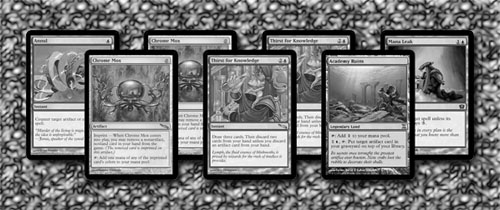
So when we talk about consistencyI think that these black-and-white images are what we are talking about. The decks we think of as less consistent play with functionally less card advantage, at least from an opening hand perspective. Now usually they are paired with greater power… There is no doubt that a Zoo deck that can attack for lethal damage on the third turn is “more powerful” than a ho hum Naya Burn deck that needs the stars to align very nicely in order to get a fourth turn concession (not necessarily kill), but at the same time, its ability to set up those kinds of draws with so many five-card openers means that it might have certain disincentives for play.
Think of the decks we complain about most in terms of “more mulligans” … A lot of those decks only play 20 lands (or not even 20 lands). Unless they are Elves (a deck of all one drops) these decks often have problems getting past Stage One (“basically manascrewed”)… And even a modest Stage Two deck will habitually beat a manascrewed opponent.
One more time for the road:
2 Umezawa’s Jitte
4 Dark Confidant
4 Lightning Helix
4 Might of Alara
4 Tarmogoyf
4 Wild Nacatl
4 Kird Ape
4 Mogg Fanatic
1 Seal of Fire
1 Tarfire
4 Tribal Flames
4 Viashino Slaughtermaster
Ironically these terrible decks I made last week will ultimately produce a very nice and useful model for card advantage that you may not be using at present. Really!
It might not be all-inclusive, but I am pretty sure it will change how at least some readers look at card economics.
To begin, I made some bad Extended decks.
Inspired by LSV in Kyoto, I decided to make B/W Tokens in Extended.
Really!
I mean B/W Tokens is a competitive deck in Standard, and recently the Philly 5K champion showed us that you can translate Block Kithkin to an easy Extended Top 4 (and if he hadn’t lost to Osyp’s infinite creature control, I’m guessing Corey could have beaten Josh and his Fae in the finals)… Fae is an Extended Deck. Kithkin can be one. Why not B/W Tokens?
Here is the first iteration:
3 Umezawa’s Jitte
4 Bitterblossom
2 False Cure
1 Ghost-Lit Stalker
3 Beacon of Immortality
4 Eternal Dragon
4 Martyr of Sands
4 Path to Exile
3 Proclamation of Rebirth
4 Ranger of Eos
4 Spectral Procession
sideboard:
3 Relic of Progenitus
4 Thoughtseize
4 Kataki, War’s Wage
1 Proclamation of Rebirth
3 Wrath of God
I decided I wanted to hybridize three major principles:
1) Three-for-ones. Two-for-ones are so passe. I played many cards that can single-handedly trip a Windbrisk Heights, viz. Spectral Procession and Ranger of Eos.
2) Martyr Combo. I figured that as long as I was running Ranger of Eos for card advantage, I might as well go and get the bestest available ones, and splash in some copies of Proclamation of Rebirth. At last check, Fae was the most popular Extended deck, and I wouldn’t be frightened of Fae with Rangers, Martyrs, and Proclamations at my beck and call.
3) False Cure combo. For those of you who haven’t seen it, the combo is Beacon of Immortality + False Cure. I pulled this off one time, ever. In a game I was just going to win with Dragon beatdown anyway.
The dream was to get in there with Windbrisk Heights to complete the False Cure + Beacon of Immortality combo. This never fit together and I think I won a total of one match with the deck.
This version was going nowhere so I tried one with Ghost Council of Orzhova. I have a soft spot for the Guildpact mobsters (especially Teysa), so I tried to make it a little bit differently.
4 Umezawa’s Jitte
4 Bitterblossom
1 Ghost-Lit Stalker
4 Ghost Council of Orzhova
1 Teysa, Orzhov Scion
4 Eternal Dragon
4 Martyr of Sands
4 Path to Exile
2 Proclamation of Rebirth
4 Ranger of Eos
4 Spectral Procession
Gaea’s Might Get There was a respectable deck, and Viashino Slaughtermaster is offensively just better than Boros Swiftblade in a deck like this one.
Sad to say I have only ever completed the turn three big swing one time, but stuck on two lands, was only capable of striking for 10. I lost that game to Swans when he locked me down with a Blood Moon the following turn (though I “got there” match-wise, eventually).
I am not hugely in love with this deck, and if you asked me today what I would play at the next PTQ, I would for certain speak the words “Naya Burn” … But this strategy definitely has legs. The reason I like it less than the somewhat similar (though admittedly “less powerful”) Naya Burn is an issue of consistency.
Consistency is a word that gets batted around a bit in Magic (especially with regards to opening hands evaluations)… And thinking about this consistency was the catalyst to this three (or so) part article set on card advantage.
sb:
3 Umezawa’s Jitte
4 Ancient Grudge
3 Lash Out
2 Pyrostatic Pillar
3 Kataki, War’s Wage
Commentary
This is essentially what I posted at the end of last week. The only difference is a swap of two Incinerates for two Tarfires. I told Osyp I wanted to play like one Tarfire and he said that he thought that Incinerate was the weakest card in my deck. If I had to do it over again, I would have played all four Tarfires and no Incinerates; moreover I would have done something with those Pyrostatic Pillars. There is a longer winded way of putting this, but they under-performed.
Part 2: Anticlimax
I went 6-2.
Osyp beat Josh in the finals, Slide over Faeries. Josh went 9-1-1 with his only loss being to Osyp.
My favorite Josh moment was in the quarterfinals. Josh came back to win Game One. He was absolutely demolished in the Faeries mirror. Stuck on three lands. Down zero Riptide Laboratories to two, lands down three to seven or thereabouts. Pulled it out.
“At what point would you would you have given up?” he asked me between games.
So Game Two. He has three mana untapped and a bunch of lands. End of his turn. There is a relevant Spellstutter Sprite on the board, but backed up by no mana.
Josh Mana Leaks it rather than spending his Spell Snare (leaving up the one for the Snare). The implications of this decision were many but I only thought one thing, almost fatherly: At what point did you get so much better than me?
So of course this was followed by untap, Future Sight (tapping out), and the concession from Ravitz 🙂
Osyp played brilliantly against Josh in what was not only a lopsided matchup (in Osyp’s favor) but where Josh mulliganed several times, and both games.
Osyp’s facility with Ghost Quarter and Astral Slide to resolve spells was the kind of stuff that they write textbooks about. They were the kind of plays that seem absolutely correct when you see them going onto the stack, but that 80% of players will never see… The same players will complain about bad draws or being mana shy when they explain why they lost.
As for my tournament, I beat Tezzerator, Faerie Wizards, the Adrian Sullivan Ponza deck, Zoo, Bant Aggro-Control, and the Lightning Bolt Deck; I lost to Faeries and All-in Red. Notably I never played Affinity.
The only interesting matchup of the day was my second bout against Faeries. I have won literally every Game One I have ever played with Naya Burn against Faeries; that said, I have lost a fair number of sideboarded games, so it was obvious to me that I was doing something wrong at some point.
The problem was at least in part that I was winning all of those Game Ones (win the flip or no), meaning that I was always on the draw in Game Two. My model included valuing Pyrostatic Pillar, so I was forcing myself to make room for more Pillars… but they are not particularly good going second in sideboarded games. I was usually cutting two Lightning Helixes to fit my three Lash Outs (though this is something I am comfortable doing in many matchups, including Zoo-ish matchups… Lash Out is almost always better since you have to invest three life to make three life under pressure); and that was sub-optimal.
So Game One I won in a hurry. Concession on turn four, I believe.
Game Two I went to Paris, took some damage from lands, and foud myself with a pair of Lash Outs and a pair of Ancient Grudges in hand (I sided in two for this game). My board was a Wild Nacatl and a Mogg Fanatic.
He was doing not so much, played Thirst for Knowledge for no bonus, untapped, and played Threads of Disloyalty on my Nacatl (1/1 on his side, I believe). I ran Lash Out for value and got in with Mogg.
He played Sower of Temptation #1; I got him with the Mogg and got more value with the Lash Out, but nothing still.
He played a naked Sower.
I finally ripped a Tarmogoyf.
He ripped yet another Sower and killed me in basically one swing.
So I was on the play in the third game. I thought quite a bit about this and decided that I was going to morph into a 100% burn / anti-Jitte deck, taking out all my Nacatls, Apes, and ‘Goyfs. The reason is that even though I “shouldn’t” lose to Sower of Temptation very often, I was not likely to beat a Threads of Disloyalty on Tarmogoyf… and this game he showed me Firespout, Sower, Threads, and Chrome Mox… and since he played Thirst for Knowledge, I felt it safe to assume he was packing Vedalken Shackles, too.
Therefore he was an anti-creature Faeries deck, and if I made myself a creature-poor burn deck, I might be able to ride the repositioning. As it turns out, he out-sideboarded me and presented two Glen Elendra Archmages. I drew two Ancient Grudges and all three Jittes but he still out-Jitte’d me thanks to Academy Ruins. The sheet said “4” at the end of the game, but he had an active Jitte, so who knows what his true life total was? That said, it was probably closer than it should have been.
My other loss was to All-in Red in two non-competitive games where he mised on the first turn. In either game if he didn’t follow up with Blood Moon I think I could have won. Nothing to say here… That deck shouldn’t do well, but you can’t complain about those kinds of matchups in the loser’s bracket.
Of the rest of my matches the most interesting was v. Luis Neiman (aka Luis not Vargas) right after I had dropped. He convinced me to un-drop and then we were paired! Pulled it out after getting face planted by Blistering Firecat in Game One (actually tagged all three games by that guy to one degree or another). Luis Molten Rained me to a Mutavault in Game Two and drew nothing, so I came back to force the third.
Part 3: What If… ?
I have to think on the new version of the deck list for a while, but I think I would play this again. Probably look something like this main:
2 Umezawa’s Jitte
4 Lightning Helix
4 Tarmogoyf
4 Wild Nacatl
4 Keldon Marauders
4 Kird Ape
4 Mogg Fanatic
4 Seal of Fire
4 Sulfuric Vortex
4 Tarfire
The Jitte’s a little out of place… Maybe Lash Out or Incinerate? Lash Out is the best burn spell in this deck after Tarfire and Seal of Fire. Yes, better in most cases than Lightning Helix. For example against one of the burn decks There was a Sulfurous Vortex in play before I even had the White for Helix! (Though admittedly it saved me from Zoo with a little careful damage stacking). In general you have to invest a couple of life to get back a couple of life… Still a great card, just not as good as Lash Out in a strategy that wants to hurt the opponent.
This video is a short showcase of Kenneth Ellis’s PTQ-winning Bant Aggro-Control deck. The Bant deck has numerous angles of attack and paths to victory (as well as opportunities to disrupt the opponent’s forward momentum). I would definitely consider playing it.
Consider this a sneak preview of this week’s Top Decks 🙂
Kenneth’s deck, which won the San Diego area PTQ the last week of January:
Now when I say that I would consider playing this deck, I am of course lumping it in a general sense with “Critical Mass” per the previous post “What Would MichaelJ Do?”. I think that either strategy could potentially gain from Noble Hierarch, particularly on the Tarmogoyf fight (Tarmogoyf race)-winning side(s).
Kenneth’s deck also plays Gaddock Teeg, which was so troublesome for me when I was playing ponderous control strategies earlier in the season; I don’t know how that would intersect with Path to Exile at this point, other than the fact that Kenneth’s deck has some basics to find and could itself benefit from some Path to Exile attention.
As you will see in an upcoming video, while Red is nice in the Critcal Mass-style sideboards, White is just a hammer. Poor Affinity.
The U/W ‘Tron deck has such powerful mana production that it can produce some awfully awful threats. This video shows off the ‘Tron offense including Sundering Titan and the Mindslaver lock.
What is the Mindslaver lock? Check out the video already!
1 Arashi, the Sky Asunder
4 Birds of Paradise
4 Sakura-Tribe Elder
4 Tarmogoyf
1 Academy Ruins
4 Breeding Pool
1 Minamo, School at Water’s Edge
1 Okina, Temple to the Grandfathers
2 Riptide Laboratory
1 Seat of the Synod
5 Snow-Covered Forest
2 Snow-Covered Island
1 Snow-Covered Mountain
1 Steam Vents
1 Tree of Tales
4 Wooded Foothills
sideboard
1 Chalice of the Void
2 Relic of Progenitus
2 Echoing Truth
2 Repeal
3 Arashi, the Sky Asunder
4 Ancient Grudge
1 Dwarven Blastminer
One of the things that dawned on me recently was how much better the cards are now than Gnarled Mass. I mean you can make the possibly true argument that Isao, Enlightened Bushi was better than Gnarled Mass, but Kitchen Finks and Vendilion Clique really make for a good argument.
It’s not that I’ve abandoned the White deck so much as I don’t think the White deck can win in a format where Storm is one of the top decks. You see Game One you have to be extremely lucky to win, and sideboarded your strategy revolves around Chalice of the Void; if the opponent is playing Luis Scott-Vargas’s version with multiple Shattering Sprees I don’t know how you can reasonably win. Sure you are going to beat the Fae, Red Decks, and so on but I think that an utterly unwinnable matchup against Storm is a dodgy proposition at this particular time.
On balance, this deck (that is, Critical Mass) has no such Storm vulnerability. In fact, I put it as the best deck in the format against Storm (at least from my experience). I have never lost to that kind of combo deck.
You have a couple of things going for you:
Your Birds of Paradise accelerates out your Trinket Mage and supplements your operating mana, allowing you to stick a meaningful Chalice of the Void before you’ve lost the game.
Your Birds of Paradise and Sakura Tribe-Elders give you a slight mana boost allowing you to play Glen Elendra Archmage with U open, as opposed to just tapping out and losing.
I really like the Storm matchup with this deck and would be comfortable playing it all day.
I like the Faeries / Wizards decks in general but I didn’t know how to win the mirror. The mirror seems quite miserable to me (but scouting from the LA floor from ManningBot seems to indicate that the mirror is highly skill intensive… I must confess that I don’t see how to gain an edge by play skill); however this deck has a fair edge over the Faeries / Wizards style of deck.
In a sense it maintains the old Kamigawa-era Critical Mass edge over Jushi Blue. You are a similar deck with fewer permission spells but tremendously more impressive mana and threats. I was in the process of beating up a Faeries player last week when he played Vedalken Shackles. I did some minor math and decided I would try to overwhelm his Shackles… A single hit from any of my significant threats would be enough. I played Iwamori of the Open Fist. He showed me Azami, Lady of Scrolls. I passed. Before the end he played an instant Vendilion Clique and drew two. I conceded game despite having no illusions of possibly losing a turn and a half before. As you can see the deck no longer has any copies of Iwamori of the Open Fist.
My current strategy is to just play a lot of Arashis. I’ve always loved Arashi and it seems fine at beating Wizards. I side the one main deck copy out quite a bit. I think I’ve only ever gone 5/5 against Zoo.
Speaking of Zoo, that is a nigh-comical matchup. You have Sakura Tribe-Elder, Kitchen Finks, and Umezawa’s Jitte all main, plus Engineered Explosives backup. Really, not a difficult matchup.
What is a difficult but not unwinnable matchup is Affinity. Critical Mass is a dog in Game One. I don’t think that the opposing win expectation is much over fifty per cent, but the Affinity Game One wins are all blowouts so it might “feel” very good for Affinity. Certainly they have some margin to play with if they run the multiple Master of Etherium version. Sideboarding makes Critical Mass a heavy favorite. You have all these great guys and all these Ancient Grudges both. I think that I have been generally lucky drawing Ancient Grudges in sideboarded games, but Critical Mass has been an overwhelming favorite in my experience.
B/G Loam has been interesting. This is a matchup that can go either way. I have won most Game Ones in tempo-oriented fashion, but like I said it can go either way. I’ve noticed that Critical Mass has become a heavier favorite in sideboarded games due to the inclusion of the second Relic of Progenitus. Previously I was concentrating on just not getting blown out by Life from the Loam and sometimes losing to the opponent drawing another one. The two Progenitus version has been much more steady and I think Critical Mass is a moderate favorite in sideboarded games, a slight favorite overall.
Overall I would not hesitate to play this deck the day after tomorrow. I have never tested it but I assume Critical Mass would be a dog to a well played and good version of the Martyr deck. Most of the other matchups seem managable if not favorable blowouts.
I have not missed Thirst For Knowlege, largely because the deck is so active and I can get some of the selection / card advantage back with Sakura-Tribe Elder and Sword of Fire and Ice… The one card I sometimes miss, though, is Pithing Needle (usually when faced with some annoying Vedalken Shackles).
Anyway, that’s my deck. I hope you get something useful out of it. Good luck this weekend to anyone playing. I suggest you obtain The Touch.
This is the “unacceptable” discussion and “solution” (if you can call it that) to You Make the Play – enCRYPTed.
… And the first You Make the Play Video response!
To refresh everybody’s memory, it was Game Three against ‘Tron. We had two up, Spellstutter Sprite in hand, fully loaded Archmage on the table and UU up.
The opponent presented Tormod’s Crypt.
The board looked more-or-less exactly like this:
So what is the what?
The first question is, do we care about a Tormod’s Crypt?
We don’t care about graveyard recursion overmuch; what we care about is that the Tormod’s Crypt can keep up from doubling up with Archmage Persist-ence.
So the first question is whether we should be doing anything about it.
I think — and it will be obvious from my “solution” to the board position — that I thought it would be worth dealing with (I care[d] about my half of an Archmage).
So the next question is, assuming we care, what we are going to do.
I have to admit that at the time (I am sure I was watching Gossip Girl out of the corner of my eye) that I didn’t even consider using the Archmage to defend the Archmage. To me, it was Spellstutter Sprite 2-for-1 or nil.
So I went for the Sprite.
Results were disastrous.
Obviously he was the super uber miser, and had not just natural ‘Tron, Ghost Quarter, and a significant threat, but Mindslaver as well.
Ka-pow!
Mindslaver connected.
Archmage died without ever doing anything profitable for michaelj (AKA Number One).
Interestingly if I had used the Archmage, I would have been in a pretty similar position (albeit with one more Mana Leak). I would have been obligated to eat the Mindslaver anyway. That said, I think using the Archmage to stop the Tormod’s Crypt was the best play.
Pat Chapin — who called my Spellstutter Sprite / terrible read “unacceptable” when I talked to him about it — said he would have done nothing. “You realize you are talking about pulling down your pants to a potential Mindslaver in order to save half a card, right?” (He said something like that).
But what is really interesting is all the things that happened next. Check that action out here:
I’m sure you loved every minute!
Oh, and before I forget – Congratulations to Joshua Scott Honigmann who won a Kentucky PTQ with a Mono-White Control deck similar to what we have been discussing the past couple of days. You go Temple of the False God!
You Make the Play returns! This time it is Fae v. ‘Tron in Extended… So are you a metagamer or a savage miser?
It is Game Three.
Your opponent is on the play on account of you savagely destroyed him with Negate and so on in Game Two.
It is game three because even though you savagely destroyed him in game two, he made you look like a child — a child smaller than your Spellstutter Sprites — in Game One, exposing the severe inability of the Herberholz / Nassif-style Faeries / Wizards deck to deal with certain kinds of expensive threats.
Namely Mindslaver.
You conceded to Mindslaver but of course filled your deck with Negate, Annul, and Glen Elendra Archmage for Vedalken Shackles, Threads of Disloyalty, &c.
If you haven’t seen the deck (you have probably seen it because all the guys who have soap boxes to stand on have been saying it’s the bee’s knees, plus you are playing it so how could you not have seen it), here it is:
4 Mana Leak
3 Repeal
4 Spell Snare
4 Spellstutter Sprite
1 Stifle
4 Thirst for Knowledge
2 Threads of Disloyalty
3 Vendilion Clique
2 Venser, Shaper Savant
1 Academy Ruins
1 Breeding Pool
1 Hallowed Fountain
10 Island
4 Mutavault
3 Riptide Laboratory
1 River of Tears
1 Steam Vents
sideboard:
1 Tormod’s Crypt
1 Vedalken Shackles
2 Annul
1 Chain of Vapor
3 Flashfreeze
2 Glen Elendra Archmage
2 Negate
2 Threads of Disloyalty
1 Academy Ruins
Okay, back to Game Three:
It is your opponent’s turn seven. He only has six lands in play even though he has been a savage miser this game because one of his lands — a Ghost Quarter — is in the bin. He plugged your Academy Ruins (not realizing you are also a savage miser and are palming the other Ruins). He has just attacked your face with his Platinum Angel, so life totals are 20-16 in favor of the degenerate mana deck..
This is his board:
This is his graveyard:
(Simic Signet, Ghost Quarter, and Gifts Ungiven)
On turn two you sent Annul at his Simic Signet, his Ghost Quarter “traded” for your Academy Ruins, and his Gifts Ungiven was successfully stifled (not Stifled) by a Mana Leak last turn after he played his Platinum Angel.
Which means, yes. Savage. Miser. He has almost a double ‘Tron, a handy dandy Island, hasn’t missed a land drop, all-natural.
This is your board:
Not too shabby. You even have mana open for your Glen Elendra Archmage… twice if necessary.
Your graveyard is seven cards:
(Annul, Chrome Mox, Chrome Mox, Thirst for Knowledge, Thirst for Knowledge, Academy Ruins, and Mana Leak)
This is your hand:
Mana Leak
Spellstutter Sprite
Spellstutter Sprite
Riptide Laboratory
Riptide Laboratory
Academy Ruins
Tormod’s Crypt is on the stack.
I would do images to show your hand and to indicated Tormod’s Crypt being on the stack but I am tired of looking up hideous background images.
Anyway, the bad guy has two mystery cards in hand.
If I had to draw a picture of this game, in total, it would look, um, EXACTLY like this:
Okay You Make the Play-ers…
He is playing Tormod’s Crypt. Ye olde zero mana spell is on the stack.
This is actually Game Two of the previous post’s brawl between Zoo and the Lightning Bolt Deck.
… But this time, we are examining the game from the perspective of the enemy!
Why is Spark Elemental worth playing in a world full of Mind’s Desires and Death Clouds? Why would the greatest player of all time have chosen this deck, let alone posted a top finish with it at the World Champsionships?
Check out the SWOT on the Lightning Bolt Deck to find out!
LOVE
MIKE
P.S. Here is Jon Finkel’s Lightning Bolt Deck from the 2008 World Championships:
3 Flames of the Blood Hand
4 Incinerate
4 Keldon Marauders
4 Lava Spike
4 Magma Jet
4 Mogg Fanatic
4 Rift Bolt
4 Shrapnel Blast
4 Spark Elemental
4 Sulfuric Vortex
I have been calling this deck the Lightning Bolt Deck largely for want of a better name.
Basically the deck has every “bad” Lightning Bolt reprint from Spark Elemental and Lava Spike on one (Lightning Bolts that can’t kill Hypnotic Specters) to Incinerate on two (Lightning Bolt for twice the cost).
In all seriousness, the critical mass of burn in the Lightning Bolt Deck can help win the game very quickly (as in the video itself). This deck is definitely on my short list.
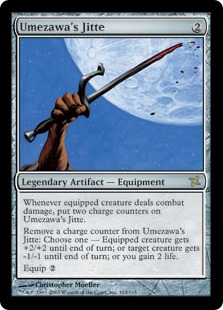 3 Umezawa’s Jitte