If you just want to get to the part about how to cheat, please raise your left hand and say “I solemnly swear I am up to no good,” and click the matching text below (but only if you promise to come back to understand the context)…
If you haven’t seen this episode of The Magic Show, I am embedding it here for you to watch (thanks good old YouTube!):
First of all I want to say that I really enjoyed this episode of The Magic Show and I don’t want this blog post to in any way be considered an attack on Evan or the Show. In fact, I generally liked his theme this week and can see players really improving their tournament performances by focusing on especially one skill at a time.
My motivation on this is about shuffling and how Evan suggests players shuffle only. I am working under the assumption that Evan is repeating something that someone represented to him as having some basis in mathematics (it doesn’t) and that person just thinks he smarter than he is, and that Evan is good-hearted and has no background in wrongdoing so didn’t realize what he was saying.
Unfortunately I am going to pull back the curtain on this one and it might not be pretty for a lot of you at home.
Let’s start at 2:20; Evan begins with…
One of the facets of this skill that I believe is much overlooked is actually randomizing your deck…
(And here Evan appropriately positions a picture of someone riffle shuffling a deck of regular cards.)
He goes on with an…
If you’re not OCD about it, then GET OCD about it!
I’m there!
My old playtest partner Scott McCord even argued that poor shuffling in playtest games was the number one source of bad playtest data!
I am personally a relentless shuffler and have practiced the mechanics of shuffling for hours, trying to figure out the best way to randomize my deck between rounds. I have done table shuffles, practiced riffling really well, and certainly studied every type of set formula (table) shuffle that cheaters use to set their decks (and see below!) that I have ever heard of. I actually spent several years doing 7-14 sets of pull shuffles in between five- or ten-pile table shuffles in addition to 7-14 riffle shuffles, which fascinated the top end of the Pro Tour.
Zvi Mowshowitz, for example, was very intrigued by my pull shuffle technique that he went on to study it himself back when his hobbies included “Magic and thinking about Magic.”
Pull shuffling, by the way, is very similar “mathematically” to riffle shuffling except 1) it takes about twenty times more time, and 2) a perfectly executed pull shuffle doesn’t actually randomize your deck; rather it simply mixes your deck base-two (like a riffle), albeit in a less predictable way than a perfect table shuffle (but almost equally not random to a table shuffle).
Anyway, Evan goes on to criticize players who don’t shuffle sufficiently between mulligans, which I can get behind.
The troubling bit comes up around 2:47, where Evan suggests:
At least two pile shuffles, if not three, with plenty of side / riffle shuffles to go along with it.
I would point out that even if pile shuffling randomized your deck (it doesn’t), these are not “OCD” numbers… But I’ll waive opinions / definitions this time for facts.
The really bad part is at 2:56, when he suggests in particular 5- or 7- card piles for table shuffling due to some mathematical word that I don’t know but that certainly doesn’t lead to randomized table shuffling.
I am going to approach this issue with three major points:
1) Table shuffling is a waste of time
2) Table shuffling doesn’t actually randomize your deck
3) Evan actually just told you to stack your deck
1) Table Shuffling is a Waste of Time
First of all, yes, I table shuffle almost every match.
I will typically do a five- or a ten-pile table shuffle (depending on how big my play area is) to open up my shuffling regimen, then do seven to fourteen superb riffles (I am an excellent riffle shuffler because I bothered to practice ten years ago when I realized I was losing to considerably worse players due to manascrews), then I do another five or ten, then another seven to fourteen. In fact I will keep riffling if my opponent hasn’t finished yet, and I don’t typically present unless I have done over 21 sets of riffle shuffles or my opponent has already presented.
“Mathematically” it takes just north of seven riffle shuffles to randomize a Magic deck.
By the way there was a point in the rules where players were forced to “end” shuffling regimens with at least three riffle shuffles but unfortunately that specific stricture has been removed from the books (I think it should be returned — but at seven rather than three — and I think that policy makers and judges who disagree with me simply don’t understand how shuffling works).
Remember we are tasked to randomize our decks, not separate mana clumps. Most arguments for “shuffling” styles other than riffle shuffling advocate separation of mana clumps when no one other than your imaginary guardian angel (who apparently doesn’t know math) is looking for that, certainly not the rules.
Remember I said it takes north of seven riffle shuffles to randomize a deck? Well as you randomize a deck more and more, guess what? Your mana is actually better and better distributed!
I am not up to speed on how judges today try to catch cheaters but I know if I were the policy maker I would do it like this:
Players would be penalized strictly based on technique. I am 100% sure a well known Japanese pro who has money finishes this year and impressive wins over some local GP and PT champions is a gigantic cheater. He stacks his deck, apparently every match. The problem is that some judges don’t understand how shuffling works (and he does) so he keeps getting away with it and they keep failing to see his pattern.
At the last Pro Tour I played in (Charleston teams), I, Josh Ravitz, and Morgan Douglass all separately caught him stacking and all called Judge! on him. I will say with complete confidence that if I say my opponent was stacking, he was stacking. End.
I am that sure I can recognize stacking when I am looking. When I was a more active PTQ player I had judges in multiple regions all commend me on how good I was at catching cheaters. I played in a Grand Prix where I caught a player stacking two matches over (against my friend edt), raised my hand, and he conceded the match on the spot, before the judge got there, because he knew he was kold; I actually got paired against him the next round so it was awesome 🙂
But for me, Josh, and Morgan to all catch the same Japanese player has to be something. He of course appealed to a Japanese judge and got a pass all three times, feigning an inability to speak English. The Japanese judge was either in his pocket (which I doubt) or (more likely) didn’t know what to look for and refused to recognize my arguments. By the end of this blog post you will not.
The unfortunate reality is that most judges — at least when I have encountered stacking but not gotten the penalty to stick, which is usually — look for a pattern but fail to find one. Here is my simple rule: The fact that my opponent is not very good at cheating, or that you couldn’t see how he was doing it, should not be the measure of whether or not he should be punished. The measure should simply be that he was stacking, intentionally cheating, sayonara.
I have been able to show judges how the patterns fall — with the cards face down even — and amazingly not gotten the call. I remember one PTQ where I was up a game with two rounds to go (undefeated) and my opponent cheated going into game two. I called the judge, he didn’t see the pattern; I set aside eleven face-down cards and told him to look at them. All eleven were sideboard cards!
… And no game loss.
Predictably I went manascrew, manascrew; manascrew next match, 12th. My opponent made the finals, cheating the whole way.
I didn’t mean this to be a rant about how cheating should be dealt with regarding shuffling. Sorry.
Think about a jar that can contain a little more than 1,000 marbles.
You put 500 white marbles into the jar.
You put 500 black marbles into the jar (these marbles are indistinguishable from the white but for their color).
What do you have?
A full jar of white marbles topped with black marbles.
Now shake the jar once; what do you have?
A full jar of white marbles topped with black marbles.
But shake it again and again, and they start to mix.
Shake it enough and what happens?
The marbles mix and mingle more and more.
This is how randomizing works: The more you shake, the more mixed they become! You can’t shake Shake SHAKE and come out with all 500 white on the bottom and all 500 black on top as you started. The system just gets more chaotic; it never becomes more orderly.
This is the problem with judges looking for a pattern, unfortunately: A perfectly randomized deck looks stacked.
Read that again: A perfectly randomized deck looks stacked.
The essential crux is that you actually get a more “stacked” [looking] deck by correctly randomizing (think of more and more repetitions with our jar) whereas you never randomize by table shuffling (the primary method of stacking).
Because as we saw with the marbles, the more you randomize, the more mixed the cards become. If you randomize really, really, well… No land clumps. Spells are distributed. Et cetera.
Riffle shuffling is a form of randomization. In fact, it is the best form for card games!
Table shuffling is “bad” for two reasons, and you already know them. The first is that it is a waste of time.
I am going to be generous and say that it takes you 30 seconds to pile shuffle your deck one time. In actuality it probably takes you 45 seconds if you are very good with your hands, but I am going to say that it only takes you 30 seconds. One pile shuffle doesn’t even distribute your mana clumps.
On balance, given 30 seconds you can riffle shuffle your deck 15 times. It only takes seven riffle shuffles to randomize your deck. You have now done twice what you had to do to randomize your deck in the time it would have taken you to do one pile shuffle, which not only doesn’t randomize your deck at all… it doesn’t even do what you wanted (even if you didn’t know you wanted out loud), which was to separate out your mana.
Why would you pile? Isn’t it stupid?
A better question: I’m not stupid. Why do I pile shuffle myself and my opponent?
Simple: Free wins.
I get free wins by not presenting some number of cards other than 60. I can recall being caught presenting non-60 one time. I lost the match for that; fixed my deck and won the next six, had to play the last round due to a first round loss, and finally lost one fair and square (raced by three Disciples of the Vault and a Ravager in the deciding game). My playtest partner with same 75 won the PTQ. I never want to go down for that one again. Ever.
On balance I have advanced from Top 8 to Top 4 because my opponent presented 59, and I wouldn’t have known but for the table shuffle; he was a 70/30 favorite to win Game One by the way, but I stole it; then I got to play two games with my sideboard. Just lucky he screwed up. In fact, I have advanced to Top 8 over a multiple Grand Prix winner because he presented non-60.
A compelling reason to table shuffle (counting)… But it is not a reason that randomizes your deck.
Now that you know that it is much less effective — even for separating out your mana — than riffle shuffling, you should also know that relying on pile shuffling for any other action than counting is tantamount to cheating.
But why?
2) Table Shuffling Doesn’t Actually Randomize Your Deck
The most common table shuffle numbers are 2, 3, 4, and 5.
Why?
Those are all numbers that are pretty convenient for 40- or 60-card decks. Simple. People look for patterns, and even piles of 30, 20, 15, or 12 cards make us happy.
Happy… but ignorantly so.
The worst thing about pile shuffling is that it is a waste of time. But it is also self-deceptive in that there is nothing random about it. It’s just a really bad way to separate out your mana (as we showed in the previous segment, simply riffling enough will get you to the point that you are nearly stacked).
Say you are doing a three-pile table shuffle.
One…
Two…
Three…
   One…
   Two…
   Three…
      One…
        Two…
      Three…
And so on. You are on card number three. How many positions can this card fall into?
Wait!
Don’t answer that.
Say you are doing a four-pile table shuffle.
One…
Two…
Three…
Four…
    One…
    Two…
    Three…
    Four…
        One…
        Two…
        Three…
        Four…
Same question: How many positions can card number three fall into?
One of three in the first, one of four in the second, right? Simple! Right?
Nope.
In both cases, card number three will always fall into position three. Now card number four will be in position one or four, respectively, but card number three will always fall into position three, and card number four will… um… always fall into position one in the first example and position four in the second example.
Have you figured this out yet?
If the cards always fall into the exact same scripted positions, with those positions varying only insofar as the number of piles, the system is itself not random.
Ergo, it is not just a poor but completely inappropriate system for randomization.
Sorry.
3) Evan Actually Just Told You to Stack Your Deck
I am fairly certain Evan didn’t know it at the time, but he just told you to commit a “shuffling” technique that has launched more than one Hall of Fame eligible career – The Double Nickel.
The double nickel is one of the simplest card cheats in the history of tournament Magic. When Evan told you to pile shuffle in a five because of a so-called SSS Prime… I don’t know who told him that was any kind of random, but as we saw in the previous section, no patterned pile shuffling is ever random, so I don’t know what kind of bogus bullspit math logic says that fives or sevens are somehow… I don’t even know how to say this other than poor Evan was misinformed by someone who thinks he is much smarter than he really is.
Instead I am just going to teach you a basic cheat.
This cheat always works because pile shuffling is not random.
It’s called the double nickel because you do two (“double”) five-pile table shuffles (“nickel”) and you have a perfect mana weave. It is a particularly effective cheat against those who think that table shuffling is random because they won’t call the judge on you. You can do some poor riffle shuffles or “side shuffles” which simply redistribute your perfectly stacked deck into different perfectly stacked positions and you will never be manascrewed; in fact you will always have a perfect draw.
Because pile shuffling is not random, and five pile shuffling is deviously not just not random, but the best known cheat.
Anyway, here’s how you do it with a Limited deck:
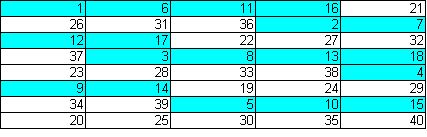
First let’s start off with forty cards numbered 1 through 40. The first eighteen are aquamarine to indicate they are land cards:
Now let’s do ye olde five-pile table. Our cards look like this:
We chunk them together into one forty card pile again, which looks like this:
Now we do a second five-pile:
When we chunk them back into one forty card pile, our, you know, “deck” what do we see?
That’s right! A perfect distribution of land and spells! It gets really dumb when we do the same thing for a 60-card deck with a paltry 20 lands 🙁
Opening stack, with 1-20 being marked as lands:
First piles, five-card pattern:
Deck looks like this:
Second of two nickels:
Final deck:
Now if you — like too many judges — didn’t know what to look for, you would miss the pattern. After all, there are several stretches of consecutive spells that seem — at least from far away — like they could be barren.
I want you to use different criteria.
Cut the deck anywhere.
There is no stretch of seven cards in a completed double nickel that that doesn’t have either two or three lands. In fact (and this could be obvious) there are literally no mana floods because there are no stretches where you get four lands and only three spells.
All you get, every time, is a perfectly distributed deck that doesn’t look to a less experienced judge like there is a mana weave pattern in play.
Take a deck — forty or sixty cards — and try it yourself.
There are equivalent cheats at different numbers that do different things. Four and eight, for example, allow you to reset an already stacked deck when you do them correctly.
But what I wanted you to get out of this blog post is that no pile shuffling is random (we already covered that it is inefficient). You use the table to count your deck. You learn to riffle shuffle to randomize your deck.
Evan, I love you man, but when you tell the readers to do “at least” two piles (read: two) and then tell them to do a five-pile or seven pile (read: five)… Don’t be surprised that their mana is suddenly coming out perfect. It’s because they were doing the double nickel, literally the oldest cheat in the Magic books.
LOVE
MIKE
PS And that’s game boys!
I’m sure a lot of you are clapping your hands together and proclaiming Halleluia! A return to old school michaelj!
There is an even easier way to access the aforementioned old school michaelj, of course. Saunter over to Top8Magic.com and grab yourself a copy of Deckade… It’s just ten years of my life, and about 700 pages of stuff like you just read.
Deckade – Because you know you want to.
PPS I am pretty sure I am going to get criticism for “teaching players to cheat” but the fact of the matter is, Double Nickel is the oldest stack in the book, and I hope I taught a judge or two something, too. This post was more a result of my wanting to respond to Evan’s video. I love The Magic Show, but in this case, Evan was accidentally teaching his viewership to do something I doubt he wanted to teach them. That said, if players really wanted to cheat, I doubt they waited until tonight to learn from me. They could have just gone and bought Penn Jillette’s book or whatever: How to Cheat Your Friends at Poker: The Wisdom of Dickie Richard
So a couple of weeks ago, I presented the following You Make the Play:
This is a seven card hand. You lost the flip so there are 53 cards in your deck and you are playing second. The deck list is the one we have been bandying about the past week or two — Jund Mana Ramp.
So… Keep or no?
The responses were interesting and varied. I was using this You Make the Play as a lead-in for some basic statistics (which we will get to) but my intrepid readership took typically galvanized positions as well as the opportunity to stand on soap boxes.
When the dust cleared (out of nineteen responses), we had a little under 2:1 ratio in favor of keeping the hand… and a handful of people who just don’t like Gift of the Gargantuan 🙂
* Zvi, by the way, said that he didn’t have to look at the hand, and if I were asking, I should mulligan it.
However, like I said, I wanted to use this as a lead-in for some basic statistics rather than a critique of the deck.
When we make plays we often do things on “gut” or fear that end up being terrible decisions. One of the worst mistakes in my entire career was in a Feature Match at US Nationals 2000.
I was playing trusty Napster in its best tournament, and riding a 2-0 open on the day, I found myself in the Feature Match area in a semi-mirror against Donnie Gallitz.
I opened on Swamp, Dark Ritual, Phyrexian Negator and Donnie started with a Duress for my Vicious Hunger. I Duressed Donnie back; his hand was all garbage – Unmask, Stupor, Masticore, and Skittering Skirge. Skittering Skirge was the best card in the hand but I couldn’t take it; Masticore was borderline unplayble in the matchup but happened to be good against my Phyrexian Negator (again I couldn’t take it), so I decided to take the Unmask.
Donnie dropped the Skirge to defend, then mized into Ritual + Persecute. I responded with Vampiric Tutor for Vicious Hunger and got in more and more.
Donnie played his unplayable Masticore (which nevertheless prompted me to sacrifice my Phyrexian Negator). Then I Eradicated the Masticore via Vampiric Tutor, then Tutored again to set up Yawgmoth’s Will.
Ritual + Vicious Hunger to start, smashing Donnie’s fresh Skitting Skirge, then I set up a Phyrexian Negator. Donnie mized into a Yawgmoth’s Will of his own, but if you go back and read the cards they were pretty pointless so all he did was make a dude.
Okay here’s my mistake.
I topdecked a Skittering Horror.
Now of course I played it pre-combat.
My plan was to smash Donnie with my Negator and sacrifice down to just the Negator, and then just kill him the next turn. But the Horror gave me another permanent and another option. So because I drew the Horror and correctly played it, I smashed in and sacrificed down to the Horror and one land instead. I figured if Donnie drew a Vicious Hunger he could make me sacrifice down to nothing, but the same wouldn’t be true of a Horror.
Instead Donnie — no cards in hand — picked up a Skittering Skirge that held me (down to essentially no permanents) off until he came back to win the game… From about three life.
In the same spot I would have just trampled him to death.
I had what Dan Paskins calls The Fear, and made a terrible decision.
I should probably have sacrificed down to double guys; next best would have been Negator and land (which was my original plan).
Dave Price described this as bad because of probability. Donnie had what? Forty cards or more in his deck? What were the chances of his drawing a Vicious Hunger (bad for two permanents if one is a Negator) versus any creature that could stop a Skittering Horror?
It gets worse.
Donnie played his unplayable Masticore (which nevertheless prompted me to sacrifice my Phyrexian Negator). Then I Eradicated the Masticore via Vampiric Tutor, then Tutored again to set up Yawgmoth’s Will.
Eradicate allows you to look through the opponent’s entire deck.
… Where I could have seen that he played no Vicious Hungers at all main deck!
I won Game Two in dramatic fashion, but just had no resources in Game Three whereas Donnie got the fast Persecute. But the fact is: It shouldn’t have gone three games.
So how does this come back to our discussion of whether or not to mulligan this hand on the draw?
The deck plays 23 lands and four Rampant Growths. I was operating under the idea “If I have three lands untapped on my third turn, I can basically make my land drops all the way to six without interruption” (six land being Broodmate range). I understand some of you think this hand is not strong v. Tokens, but you probably haven’t played the matchup as much as I have. Tokens is often a Batman / Vs. System battle where you just play something better than what they play, top up on your six, and then play sixes every turn while they are still piddling around with three 1/1 creatures (which actually get soundly stomped by some of your sixes).
So…
How do we get to three untapped lands on turn three?
1) We can draw any land on turn one or turn two.
2) We can draw Rampant Growth on turn one or turn two.
3) We can topdeck one of 13 comes into play untapped lands on turn three.
So here are our probabilities.
Turn One – 25/53
Turn Two – 25/52
Turn Three – 13/51
You have twenty-five options on turn one – any of the twenty-one remaining lands, plus any of the Rampant Growths.
You have twenty-five options on turn two (assuming you did not already fulfill your minimal requirement on the first turn) – the same twenty-one lands and the same Rampant Growths. Note that this only works because you have two lands that come into play untapped in your opening hand; the math changes dramatically if you have a different land configuration… For example if both lands came into play tapped, you could not count Rampant Growth without an intervening untapped land pull (which itself would have fulfilled what we need fulfilled).
Turn three you still have options but they decline sharply. You lose eight of your lands (Treetop Village and Savage Lands come into play tapped, so drawing them on turn three is useless in the short term; ditto on Rampant Growth).
Most players can evaluate a situation like this one and look at the first turn. You are under 50% likely to pull a relevant piece of mana on turn one.
You are similarly less than 50% likely to pull a relevant land on turn two. But what about the fact that you get turn one and turn two both?
Turn three is much less likely than turn one or two, but you still have a nice lift… That is an “advantage” of going second in this hypothetical.
So how likely are you to pull the right land?
You start with 25/53, or about 47%… That’s yours, that slight dog / coin flip.
Of the remaining 53%, you get 25/52 (or about 48%), an addition 25%.
So here is the super tricky part. Of the 75% of that lost 53%, you get there another 13/51 (~25%) of the time… about 7%.
Ultimately you’re in at about 79-80% likely to have three untapped lands on turn three.
A faster and arguably easier way to come to the same conclusion is to figure it out in the negative. How unlikely are you to have the land you need on turn three? Your likelyhood of actually having the goods is whatever is left.
Relative likelihoods of drawing non-relevant cards:
28/53
27/52
38/51
Multiply all those together and you’re a hair over 20% not likely to get there… Or 79-80% to have the mana you need (just like we said).
So what happened?
80% is a pretty good bet, so I kept.
It turned out that my opponent was Reflecting Pool Control, one of the deck’s best matchups, and of all the matchups in Standard, the most vulnerable to this type of hand (incremental card advantage via small threats).
So of course I missed my third three times, discarded, and lost one of my best matchups 🙂
For you, a YouTube video about new It Deck Cascade Swans. Not just a Regional Top 4 deck anymore, Cascade Swans has just taken a Grand Prix title!
I used Parth Modi’s version of Cascade Swans, as (as I mentioned in the previous blog post) I used to make this video before the deck went and won a Grand Prix. For those of you who haven’t been paying attention, here is ye olde deck list:
So a lot of people have been asking why I haven’t made a video in forever.
It is actually a different answer than why I didn’t update this blog for like half a month.
Basically remember when MTGO was super slow and it was un-possible to get a game? That short spell kind of got me in the habit of not playing MTGO for a while, and then every format got super boring due to not being in step with the actual Constructed formats due to set differences. I’d say that all of that is behind us… but instead I just hope that you like this video.
Cascade Swans… Cascade Assault… Whatever you want to call it, it may be the hot new It Deck of the Standard format. We took a spin with it to give our first impressions of the team of Bloodbraid Elf, Seismic Assault, and Swans of Bryn Argoll!
Numerous people including Josh Ravitz and my man Iñigo Romero Martialay told me I should take a look at some new Cascade Swans deck. I had no idea that there was any other kind of Swans deck than the familiar control-esque Extended port as I had not looked at all the Regionals Top 8 deck lists yet. Little did I know that this deck was / is the realization of this little snippit you may have seen on Facebook…
Well Kowal, it was actually forty-two lands.
I looked up the deck lists on ye olde Mother Ship and battled out with this bit of innovation by Parth Modi:
For those of you who haven’t figured it out yet, this deck is chock full of lands (many of them functional). So it doesn’t draw much other than lands; there are four major spell slots, which stick together two-plus-two like LEGOs:
Bituminous Blast and Bloodbraid Elf
Swans of Bryn Argoll and Seismic Assault
The Cascade twins are there to flip the functional cards. Bloodbraid Elf can literally only flip over Seismic Assault; Bituminous Blast can flip any of the other three cards (the cream dream of course being Bituminous Blast into Bloodbraid Elf into Seismic Assault).
With such a dense percentage of lands, the Swans + Assault combination is generally lethal. That is, every land pointing at a Swans of Bryn Argoll is 70% likely to flip another land; a minimum of one land per cycle will at least “keep you going” more or less “forever” until such point that you have 10 lands to throw at the opponent’s noggin.
Ad Nauseum has generally less risk in this deck than most because there are lots of lands. You can pick up lots of lands to kill the opponent with a Seismic Assault, or pick up essentially any of the other cards to set up or complete the combo.
I took the deck for a spin in the Tournament Practice room last night. Here’s how it went…
ONE – Howling Mine / Fog deck
This matchup is basically un-losable. You don’t even really need “the other half” of the combo because if you set up the Assault they are giving you plenty of fodder to kill them to death.
1-0/2-0
TWO – G/R Beatdown “Red Deck”
I actually took some footage of this matchup, which time willing, will end up on the long-lost Five With Flores YouTube page this weekend.
Game One I had him dead (he was all tapped out and such) and I played Ad Nauseum. I was quite beaten up and went to five on Ad Nauseum and decided to keep rolling (I don’t know what I was thinking). Actually I do know… I was thinking my deck has Swans and Elves and I can go to one because he is tapped out. Forget about the fact that I had just played a five. So of course I killed myself.
Game Two I won easily on turn four, playing the Assault then playing the Swans; his interaction was minimal.
Game Three one of the weaknesses of this fledgling strategy was revealed. It is fast in the sense that it can win on turn five, but the Cascade Swans deck isn’t fast-fast, and can’t really defend itself very well. Plus a big chunk of the cards are these clumsy fives that you can’t even play in a lot of games. So he had a Tattermunge / Jund Hackblade draw and just raced me.
1-1/3-2 (Should have been 2-0/4-0 though, due to Game One killing myself on unfamiliarity).
THREE – Five-color Zoo
This matchup is a mess. It’s basically like it would be against Jund Mana Ramp. I don’t think that Cascade Swans has a very good chance, ever. He just went good guys, then kolded my Swans with a Cryptic Command and killed me with an Anathemancer (Jund can do the same thing with a Shriekmaw / Makeshift Mannequin). Finks, Finks, Treetop, etc.
Game Two I actually drew a lot of spells! It was kind of funny. I couldn’t cast my dumb Bituminous Blasts, of which I had four in grip. He Runed Halo’d me, which revealed that you basically have to side in the anti-permanents package every single game. I did not. I was defeated soundly; his Identity Crisis was gravy.
1-2/3-4
FOUR – Turbo Mill
Game One I beat him very tricky-like. I played an attrition / exhaustion game, and killed him in response to Jace ultimate + Hideaway lands on a tap-out. It was very late and I had already forgotten the lesson of the previous match, and neglected to side in any of my artifact kill. Embarassingly, I was kolded by lots of Pithing Needles in the second, and just got my relevant jones countered in the third (not that hard when you have almost no spells).
1-3/4-6
FIVE – Finest Hour
Game One I got the super dream:
Turn two Spinerock Knoll, imprinting Swans of Bryn Argoll.
Turn three Seismic Assault.
Turn four point eight at the opponent, activate Knoll, complete the combo. He actually had a Bant Charm for my Swans, but I had enough lands in hand at that point to win in response.
I stone fell asleep during the second game and conceded match. It was quite late and I was literally only up on account of being super pissed off at the Cavs’ losing to the dumb Orlando Magic last night, giving up a sixteen point lead, yadda yadda yadda. I’m sure I would have won the match, though 🙂
1-4/5-something
Preliminary Analysis:
The deck is actually insane in Game One situations. I won almost every Game One despite having no familiarity with the deck and actually being so unfamiliar that I killed myself with my opponent literally dead to the cards I already had set up.
However it is incredibly easy to hate out in its present configuration. Like I said already you kind of have to side in anti-Pithing Needle and anti-Runed Halo cards Every. Single. Time. Because of that I think that Maelstrom Pulse should be a sideboard four-of, specifically due to the kinds of cards you will likely see set up against you (permanents in play, often in multiples).
My preliminary testing shows that Bituminous Blast is godawful. The so-called cream dream doesn’t even set up the full combo, and five mana is a lot to ask, even from a deck that will hit five lands on turn five almost every game. This may sound stupid, but I couldn’t play the Black for Bituminous Blast more than once. Don’t get me started on playing Bituminous Blast in order to flip over Qasali Pridemage. Just embarassing.
The man lands were kind of irrelevant. I know what they are supposed to be there for, but my Encampments just got eaten by Plumeveils and Jund Charms more than once.
It has been said elsewhere and I think that I agree on switching out Bituminous Blast for Deny Reality. Deny Reality gives you a functional card in terms of being able to deal with a combo-hating permanent that can potentially set up the win.
Despite my reservations with the deck — and absolutely dismal batting average in ye olde Tournament Practice Room — I would say that this is simply the most compelling strategy in Standard other than Jund Mana Ramp. My intuition is that the deck is a dog to some of the actual decks I like, but it is also the kind of deck that many Pros automatically gravitate toward when selecting a deck. It is powerful, and you get what you get (other than the iffy swings on Bituminous Blast). The Game One capabilities alone make it a good candidate for closer review, regardless of one man’s initial W/L.
I went to the Whole Foods at Columbus Circle tonight. My nominal task was to get some apple juice for Clark. However while I was there I also got Katherine a Kombucha and some sage sausages for me and Clark (honestly I was just hungry for din din).
After gathering these scant groceries I assessed my options. I could 1) stand in a line that stretched all the way through the cheese section, past the cookies, and into the prepared foods, 2) get in the sushi line (which would give me an excuse to buy some sushi for Katherine, which might make her happy), or 3) get in the coffee line. I opted for the coffee line because it was already after 8pm and Katherine would have probably already had dinner; anyway I always stay up until 2am or so writing on Monday nights, so I figured an 8.30 caffeine infusion would be the best of the three options (also cheaper than random sushi). You see at Whole Foods if you want to avoid the unending lines you can check out at one of the other sections by buying sushi, coffee, clothes, whatever is appropriate.
Anyway I guess most people don’t know you can pay a $2 coffee tax and circumvent a 20 minute line so there was only one person ahead of me in the coffee line. However this “line” of only one person Did. Not. Move. Why? The guy ahead of me was rummaging around in his man-purse, rummaging, rummaging. He did not find whatever he was looking for. “Sorry,” he said, shrugging. He had not found his wallet.
“Not a problem!” said the guys at the counter.
Swipe.
Amazingly, the barista at the coffee counter bought his groceries for him.
I was stunned.
The guy ahead of me in line was maybe more stunned, understandably grateful.
“You don’t have to do that!”
“It’s a little too late for that!” laughed the barista. “You have a nice night now.”
The guy ahead of me in line, teary-eyed, took a moment to creep his head forward and check out the names of the men behind the counter, committing them to memory, saving up for future gratitude.
“I’m in here every day,” he stammered. “I’ll… I’ll…” You can probably finish the sentence he was trying to get out with your own imagination.
I know this post is a grand departure for this blog. But I was just so moved I had to write about it while it was still fresh in my memory. We fixate on every negative emotion in the world, dwell on every tiny mistake, and talk about nothing in our national news but our swiftly crumbling economy. But even in the midst of these collapsing financial times, it looks like there is opportunity for tiny expressions of generosity to our fellow human beings, even in the heart of that busy zoo called New York City.
I had two sheets of folded up paper in my man-purse. I threw one of them away. I pulled the other out just now to write this (terrible) tournament report and realized I had thrown away my notes from the actual tournament I played in and kept one probably from like a PTQ last summer or perhaps an old grocery list.
So basically I am going to get ~80% of the details wrong, not remember anyone’s name, etc.
Deck:
You know the deck.
Car ride:
I rode in with Josh, Chris Lachmann, and two of Josh’s good friends, Eugene and Sharbel. The last time we had more-or-less this configuration was a Philadelphia PTQ (the one I played Slide), which was minus Sharbel. Chris won, Josh and I finished in the packs (aka first loser). Josh played G/W Tokens, Eugene played U/R Swans, Sharbel played Blightning Beatdown, and I played my Jund Mana Ramp deck obviously.
Last-minute cards:
I tried to buy Karrthus, Tyrant of Jund on-site and it was like $8. No way. So I am running around trying to mise Karrthus to no avail. I go back to the dealers. Five dealers. No Karrthus. Karrthus is sold out! Part of me grins; the other part is like “Man, I hope I don’t hit any mirrors.”
I am writing down my deck list with two Terrors and Phil Napoli (aka PNaps) flips a Karrthus at me. “I thought you didn’t have any,” I say. Phil grins and says he didn’t have any in his bag. His car was another story. Due to the generosity of people like Good Man Dan (also playing same 75 due to following the two blogs and listening to the ‘casts) Will and I had Tyrants to spare.
Most of my deck including signed fancy basic lands was courtesy of Josh Ravitz; Luis Neiman (aka Luis not Vargas, Stan Bush heartbreaker) generously provided my final Kitchen Finks and a set of deadly Anathemancers.
Again, I don’t have my notes and have therefore successfully lost most everyone’s name.
As I’ve said previously Blightning/RDW and Fae were the two decks I was most frightened of. The reason is that I think I have a good matchup against Blightning/RDW but my deck can stumble inside of turn four, and the Red Deck might put me in a no-win position before I cast anything meaningful. Fae I have a great matchup there, but Fae is Fae and I have lost to enough Mistbind Cliques over the past two years to have any moronic ideas about Fae’s demise (Josh actually theorizes it might be the best deck again as soon as next week in the PTQs).
Anyway this Blightning matchup was super easy. No real details. He didn’t kill me. I won the flip. I ran out my accelerators and speed-bumps and dropped at least two Broodmate Dragons per game. He tied up his cards going in the hole trying to contain the Dragons, but you know how that goes.
1-0/2-0
Round Two – U/R Swans
I actually got paired against Eugene super early. Eugene has a great fear of Treetop Villages, which ended up being warranted in this matchup. I did like nine with Villages in game one. Eugene hit all his land drops but they were like Ghitu Encampment and multiple Mutavaults, so even though he hit like seven in a row he couldn’t play his UUU cards such as Plumeveil and Cryptic Command, ergo, couldn’t defend himself until it was too late.
Game Two I drew multiple Anathemancers; there is a reason I have that card as #1 overall from Alara Reborn. It’s just the best threat that has been printed in some years. It’s a Lightning Bolt when it comes down and hits for another four like every time, so seven damage for three mana, and then if the opponent doesn’t have a specific answer to it such as Runed Halo or Pithing Needle, he is just going to lose 100% of the time to the blowback.
2-0/4-0
Round Three: U/W Reveillark
He had beaten Good Man Dan the previous round, so maybe he had a good matchup v. our deck.
Game One I got some damage in with Treetop Villages and Civic Wayfinders. He got a Sower of Temptation and started to attack me for four while I just kept picking up lands. Then he super sized a Figure of Destiny, which was pretty awful. I managed to play a Broodmate Dragon but declined to block when he attacked me just with his super duper Figure of Destiny (had he attacked with both 2/2s, he could have also activated Windbrisk Heights). I took. I think I would have been dead if he had attacked more vigorously for the two previous turns; however he later said he feared of Volcanic Fallout. Turns out I got just enough time to pick up Banefire. Ha ha!
Game Two I got land and spells, including big super spells, but he successfully played Gather Specimens on both my Cloudthresher and a Broodmate Dragon. I had a Banefire but was forced to point it at my Cloudthresher instead of playing for a win because I had no life gain in my deck (if I had so much as a Kitchen Finks I would have played like Craig Jones); I looked at the game over the next three turns and there was just no way I could stay alive long enough to win by topdecking a second Banefire unless I could buffer my life total by at least two points. Anyway, I figured I could try to get in with the Broodmate… but another Gather Specimens. Guess I got what I deserved.
Game Three I kept smashing his board with Caldera Hellion and once he had UUU3 up I didn’t play a creature until I had Shriekmaw backup (it was a Cloudthresher at end of turn to set him up, obviously, which was worth a Fireball and more. This deck was pretty easy to beat once I knew not to get blown out by Gather Specimens.
3-0/6-1
Round Four – RDW
I played against friend and Broodmate Dragon + Makeshift Mannequin godfather, Spencer Reiss. He was going to play the Jund but was allocated RDW in the deck distribution shuffle. I feel like this matchup is about a 70/30 in favor of Spencer’s version in Game One, provided he wins the flip (which he did). Spencer generously offered the lay down if I was planning to go to Nationals anyway, but I assured him I was only going to go if I had a reason to, so he took up the opportunity to blow out the Old Man.
Game One I didn’t actually play a spell. I shipped into a low action hand that was at least going to make its drops and gambled on a sub-optimal draw on Spencer’s part to try to mise into dropping the Broodmate Dragon, knowing that I was probably going to lose whether I shipped or not; at least this hand had a plan. What actually ended up happening is that I activated my Treetop Village to block and Spencer Incinerated it; then I packed.
Between games I declared that Spencers’ first land was going to be Ghitu Encampment, I was going to hit my mana gathering spells, Primal Command his Ghitu Encampment and gain seven life on turn four or five, then he was going to concede to my Broodmate Dragon on turn six.
It turns out this is exactly what happened!
Game Three I had a slow draw to his pretty solid one, but Spencer was stuck on three for about two turns. His fourth land, coming maybe turn five or six, was a Ghitu Encampment; I put it on top of his deck three turns in a row, gaining seven while hitting my land drops. Then I played the first of three Broodmate Dragons. I couldn’t start dropping Dragons earlier because I was low enough that if Spencer had two burn spells he might kill me on the spot, but if I made the repeated Primal Command play, I could keep his mana tapped (ensuring he couldn’t fizzle my next Command), guarantee he couldn’t play Demigod of Revenge even if he topdecked another land, and net 1-2 life per cycle while hitting enough land drops to play Broodmate Dragon with enough mana to activate Treetop Village as a chump blocker if need be. It ended up working out.
4-0/8-2
Round Five – Reflecting Pool Control
The entire tournament I probably made lots of errors that are not going to make it into this terrible tournament report, but really the only one that mattered was in Game One of this match. I had a hot hand with three Banefires, and I started pointing them as soon as I had enough mana for them to go Hellbent. My opponent Ben made me pick up one of my two Treetop Villages after my second Banefire, and I picked up a Savage Land the next turn, which also comes into play tapped. In kind of like one smooth, lazy, motion I dropped the Savage Land instead of the Treetop Village and fired again. Ben asked how many cards I had in hand; he was now Ultimatum-online. The five life he gained that turn kept him out of dead that turn whereas I had to drop Broodmate Dragon, Cloudthresher, and Treetop Village, keeping the Banefire. I shot him to two. He hid behind a Plumeveil for about three turns until he had a Broodmate Dragon of his own to kill me. Had I played the right land, he was just dead; instead he sat on two until he drew a Wall of Reverence to go up four. I died with Fallout as my top card.
Game Two I got him with Anathemancer, Banefire, and Primal Command. The sideboarded matchup is like 75% in favor of Jund Mana Ramp, maybe more. They have like two cards that are more powerful than any of seventeen cards in your deck, and they basically pack if you ever resolve a Primal Command (in fact I was dead on board when I picked up a Primal Command, which I used to go not dead on board thanks to +7, and I got an Anathemancer, which stuck). Of course if it hadn’t stuck, I would have still won on the blowback.
Game Three Ben got me in the complete lockdown – Three Runed Halos and two Pithing Needles (one on Treetop Village, one on Anathemancer). This one could have gone either way for a long time, even after his Cruel Ultimaturm, and I had lots of pulls to win on the spot even with all those permanents down. As late as the last turn I could have drawn a Primal Command (he didn’t have a counter) and won the same way I won Game Two (except putting Runed Halo on top instead of gaining seven). However I blabbed about this and he figured out to just put another Runed Halo down on Anathemancer 🙂 Live and learn.
I also made a “judgment call” in Game Three; I don’t know how much it mattered. Ben tapped down for something (a Mulldrifter maybe?) and I had an Anathemancer in hand. At this point I had a Makeshift Mannequin and he had his Needles already. I could have played the second Anathemancer and hit him for four or five, plus an attack. Instead I played Broodmate Dragon, which merely drew Wrath of God. He had enough mana the subsequent turn to play both Wrath of God and Runed Halo on Anathemancer so I never got that damage in. As the Dragons never hit him, either, I have been wondering about the relative efficacies of both plays. Like I said, I didn’t feel like this was a clear error, and Ben won by enough margin that I can’t point at it like the Game One Treetop flub as a clear match loser.
Ultimately, the thing I am bitter about is not the Treetop Village screwup (okay, lies), but that the crowd really was looking for me to topdeck Karrthus when he tapped out for Broodmate Dragon, and I felt like Ben’s win really robbed the crowd of what they were looking for — nay — deserved. Ben won the next round and made Top 8, though I don’t know if he won or not.
4-1/9-4
Round Six: Fae
I played against Morgan, who I had successfully not bought Karrthus from for $8.
I felt like I made maybe 1.5 relevant errors in my previous match, but in the games against Morgan, I feel like I made about 20 errors in each of the two games I lost (sorry for ruining the suspense). You tell me.
Game One Morgan played Bitterblossom on the play, turn two. My first play was Treetop Village, and my second Fire-Lit Thicket. I looked at the Volcanic Fallout in my hand and said to myself “I need RR for this,” and — not thinking — Thawed up a Mountain! No! Morgan then showed me Scion of Oona on turn three to play his land untapped, and passed. So I have a Volcanic Fallout but I assume he is going to autopilot the Scion down at the end of my turn, so I do nothing when I should have played Gift of the Gargantuan. Not playing Gift of the Gargantuan this turn probably cost me the game. Why?
Morgan didn’t in fact play the Scion so I wasted my turn. He played it the next turn, and at this point I had a fourth land and ran out Cloudthresher for four as I had a bonus Thresher, Mannequin, and Fallout all in hand, as well as a dead Shriekmaw (Shriekmaw isn’t dead-dead, just not very good against Fae). So on my next turn I play the Gift I hadn’t played. Probably fearing another Cloudthresher, Morgan throws a Broken Ambitions at it. He wins the Clash.
Flipping over my only Swamp, which was the second card.
Okay. I don’t have a Swamp anymore. Meaning I can’t play Shriekmaw, or Mannequin, or the next Shriekmaw I pulled, or any of the Broodmate Dragons I might draw, unless I get my hands on a Savage Land.
Blah blah blah. Morgan’s draw isn’t even that good. He eventually kills me with a Mistbind Clique. This is horrendous because my highly card-advantageous deck was able to bleed him for his hand, and I actually lost with both Cloudthresher and Volcanic Fallout in hand! How badly did I have to play to be able to say that? But the real pisser is that I could have avoided all the drama by getting Swamp on turn two, which would have given me three shots to Mistbind Clique before I lost.
Game Two Morgan is manascrewed and I get him with a pair of Finks even though I am also manascrewed (degrees, etc.). Game Three I literally said “Just don’t topdeck a Cryptic Command,” when I passed with a double Dragons, Kitchen Finks, and Treetop Village all on board, Fallout and Banefire in hand… He chuckled and showed me the Cryptic Command on top; his alpha strike put me to -2.
And that’s game boys!
4-2/10-6
Round Seven: Bant
Okay, playing for pride (and packs) at this point 🙁
Game One I shipped to five, and got a playable if not-very-good hand of acceleration and a Broodmate Dragon. He went Rhox War Monk, Rafiq, Noble Hierarch, and that new-fangled Armadillo Cloak-Hammer thing. I gloriously double-blocked the War Monk, which of course just resulted in two dead Dragons. I conceded with him on 36 life and me on no cards.
Game Two he played Gaddock Teeg and Meddling Mage on Volcanic Eruption, which was not really good for my hand or plan. I just kept playing two-for-ones (Civic Wayfinder, Civic Wayfinder, Gift of the Gargantuan) and putting him in a spot where he couldn’t really attack me. Then I got to the expensive guys and won with a series of Alpha Strikes from the high ground.
Game Three it was his turn to go to five. He was screwed on Ancient Ziggaraut, which prevented him from being able to dig out of my massive advantage on the board with a Wrath of God. Basically he played a guy, I played a two-for-one, he played a bigger guy, I killed it with a two-for-one. I think I drew all three Hellions this game.
5-2/12-7
Round Eight Jund Cascade Ramp
Game One he was “winning” the whole game with his little Cascades with Bloodbraid Elf and getting damage in; I ramped a bit and played two Dragons; he played two Dragons. He attacked with both his Dragons and two Treetop Villages, tapping him to one. I dealt myself two during combat and blocked to one life thanks to Cloudthresher. The counterattack was for 15; Banefire took care of the remainder.
Game Two I thought it was kind of interesting we were playing a faux mirror and his main deck Anathemancer did a total of one damage in Game One whereas any Anathemancer I would draw would dop like super infinity. Anyway he played a Spellbreaker Behemoth, which I was pretty sure was going to kill me. I had to cut Shriekmaws because I didn’t think they would be very good, whereas I had to keep Kitchen Finks in my deck because he played Chameleon Colossus.
Lachmann later asked me how bad the hand was that I kept in order for me to have lost to a Spellbreaker Behemoth, but I kept a very mana-y hand with a Broodmate Dragon. Our mirror model is based on the game being decided in Game Three by complete domination of metrics (cards, board, bombs, possibly just Karrthus), so we usually dump all the Finks and just play the two-for-ones and things that cost six or more. So I had no answer to his simple Blastoderm. I ran out a couple of Dragons, but he just kept playing Bituminous Blast + evoke Shriekmaw or Bituminous Blast + Maelstrom Pulse. So Game Three.
Game Three… I don’t actually recall how I won this one. I think I got some Shriekmaw two-for-one on his Gruul-colored threats, I Banefired his Colossus, and had enough six mana threats to out-last his Bituminous Blasts &c. Unlike Game One this one wasn’t particularly close… I just don’t remember the details other than burning out a Chameleon. Sorry, long day 🙂
6-2/14-8
Honestly I feel like this version of Jund Mana Ramp might just be the best deck in Standard. I can track my first loss to a very clear error, and my second loss was just circus magic. “Circus” as in it was like I was driving a clown car I made so many mistakes. Story of my life, right? Just gotta play a little bit better and I’m Top 8; oh well, I didn’t. You have literally no blowout matchups, and you can beat any deck; in fact you are a clear favorite against numerous top tier decks such as Reflecting Pool Control and G/W Tokens, and basically any “creature” deck that is smaller than you are.
I know some readers don’t like Gift of the Gargantuan, but I feel like you need it to make plays relatively early and to lace the deck together; there are only 23 lands and you are very mana hungry.
One thing that I have been kind of bothered by is that if I had played Maelstrom Pulse instead of Gift of the Gargantuan I probably would have just gone 5-0 to start, eliminating any and all Runed Halos, which would have allowed me to easily win Game Three against Reflecting Pool Control. Also if the “Fog” deck picks up in popularity, Maelstrom Pulse is a great tool there, especially any turn they tap out. Given the nature of the threats in this deck (seven uncounterable burn spells, access to four Primal Commands in sideboarded games), I think that adding Maelstrom Pulse can put that matchup on borderline unwinnable for Fog. Just a thought.
Tee Shirt:
I have played three tournaments with the You’ve Got the Touch tee shirt now. I didn’t win any of them, but I haven’t so much as made an individual PTQ-level Top 8 in two years. However, I have finished in the prizes in every single tournament, despite playing Green each time, whereas before starting to wear this shirt, I had not finished in the packs since Regionals 2007. So… touch or no?
Courtesy of our friend Luis Neiman (aka Luis not Vargas aka @l_neiman)… Basically the worst thing that has ever happened to music, Optimus Prime, or… well… music.
At long last, another edition of You Make the Play!
This time it’s an easy one… Do you keep this hand or not? Why or why not?
This is a seven card hand. You lost the flip so there are 53 cards in your deck and you are playing second. The deck list is the one we have been bandying about the past week or two — Jund Mana Ramp.Â
PS Did you cats see that the great Luis Scott-Vargas (LSV) and long-lost RidiculousHat posted on Mis-assignment of Strategy = Options Amputation? Might want to check out the forums from the previous post!
I have gotten a flurry of questions about my opinion on Luis Scott-Vargas’s most recent article on ChannelFireball.com about mid-range decks and Jund Mana Ramp in particular. Luis is a player who for a long time came out of the tradition of The Rock. Even when he was not actually B/G on his colors, Luis played with Loxodon Hierarchs, hand destruction, incremental advantage in general.
Though Luis had a great deal of success with those strategies (US National Champion and all that), he did not enjoy the kind of colossal Pro Tour success that he is riding today until he changed from playing The Rock to combo decks. You will remember his Extended win was with a combo Elves deck; he has since played all manner of Swans, Storm, and so on with peerless results.
This is great for Luis! We have always liked him and wish him every fortune in the world.
The emails and Tweets, though, come from another angle. Luis says that mid-range is an intrinsically flawed strategy, and argues quite strenuously against the strategy that Will Price and I like the best today: Jund Mana Ramp.
To wit:
This is a classic example of the midrange non-blue control deck. It can’t compete with the Cryptic Commands and Cruel Ultimatums of 5-Color Control, and has to settle for running much worse stuff like Primal Command and Garruk Wildspeaker. You may consider this as a 5-CC deck that doesn’t lose to aggro Red, but in return for a better (and not necessarily even good) Red matchup you are so much worse against Faeries or Reveillark. I’m not even convinced that Jund Ramp (or any non-blue Ramp) even beats Token decks.
Well my reaction to this part — which is really the genesis as that is what readers have been asking about specifically — is that it must not apply to us. Let’s look again at our version of Jund Mana Ramp:
Jund Mana Ramp
3 Makeshift Mannequin
3 Shriekmaw
4 Broodmate Dragon
4 Kitchen Finks
4 Civic Wayfinder
4 Cloudthresher
4 Gift of the Gargantuan
4 Rampant Growth
4 Banefire
3 Volcanic Fallout
4 Fire-Lit Thicket
8 Forest
2 Mountain
4 Savage Land
1 Swamp
4 Treetop Village
I have for some time been a vocal opponent of the Garruk Wildspeaker version of Jund Mana Ramp as slow and clunky and overly vulnerable to Faeries. Heads up I am not convinced that Garruk does anything … Though it is obvious that the potential for a Violent Ultimatum fueled by the Fertile Ground + Garruk + seven drop draw that only occurs on daytime soap operas is quite the boogeyman. Before I get into details (and what today’s title means), I will address Luis’s paragraph on Jund Mana Ramp…
I would agree that this deck probably doesn’t want to get in a Cruel Ultimatum fight with Reflecting Pool Control. However that has not historically been a problem, and I anticipate it to be less of a problem this coming weekend. At New York States last year, I handily dispatched every Reflecting Pool + Cryptic Command deck I played in that tournament, albeit with the help of Mind Shatter + Gutteral Response (which was like the simpler, faster, Cruel Ultimatum). Point being, I respect the Ultimatum, but don’t anticipate the matchup as being a huge issue. In fact I would have been very happy to play Reflecting Pool Control all day at States; it was in fact the deck I tested against the most and I felt like I had a superb understanding of how to dominate.
For Regionals I am not sure how to consider the comparison. For one, I think that Reflecting Pool Control is a disaster. Not a disaster for Jund Mana Ramp… like it’s an unplayable time bomb waiting to blow up in the face of whoever has decided to play it. I don’t have Mind Shatter + Gutteral Response any more because I don’t plan to have to have those cards. If I did, I would commit the sideboard space. Instead I have a much improved main deck that can torch the opponent out at will and a sideboard that features the card that I believe should extinct the Reflecting Pool Control strategy: Anathemancer.
I already said I don’t like Garruk Wildspeaker… but I grandly disagree that Cryptic Command is in any way better than Primal Command. Remember I have included Primal Command as a four-of… but a sideboard four-of that only comes in when it is an appropriate tool. I have steadily increased the number of Primal Commands in my sideboard because I really want to draw them in these matchups where I want to draw them (beatdown decks, Sanity Grinding, and the mirror). When I played Blightning Beatdown, there was nothing I wanted to play against more than a deck with Cryptic Command, whether it was Reflecting Pool Control or Fae. In both cases I felt like I was a heavy favorite, and I got to play with Gutteral Response to force mana commitments while I still resolved my threats.
Perhaps in agreement with Luis, I actually don’t think Red Decks are that easy for at least my version of Jund Mana Ramp. I feel like I have a good chance, but I would much rather play Fae or Reflecting Pool Control or certainly G/W Tokens than a Red Deck. That is why I have Primal Command. I want to grind the Red Deck into the floor, and gaining seven life while loading up on Kitchen Finks and Broodmate Dragons is the most appropriate way to do that in this format. Against Sanity Grinding, a Primal Command is actual card advantage, trading for multiple spells the opponent has played, and hwen it resolves, demoralizing the Millstone strategy. And of course in the mirror Primal Command is arguably the single strongest card, setting the opponent back on a comes into play tapped land and putting Karrthus into my hand.
I don’t look forward to playing Reveillark, but I actually think Fae is a very easy matchup for this version of Jund Mana Ramp. I lost to Fae to miss Top 8 of States, but I think that that deck — and even more this deck — were and are heavy favorites against Faeries. In fact, I think that my version of Jund Mana Ramp is a nightmare for most Faeries players. I side into eight copies of Volcanic Fallout and Cloudthresher (seven starting) and I have very little dead weight (only Shriekmaw) and no obvious targets. The paths to losing are being manascrewed or the opponent drawing multiple uncontesed Mistbind Cliques. I respect the latter, though, and am considering playing a second Terror in the sideboard specifically to help deal with this draw.
But Tokens? In our testing B/W Tokens can be competitive but Jund is the favorite; I don’t think G/W Tokens has very much of a shot. Testing online (where admittedly G/W Tokens doesn’t have Dauntless Escort yet we have yet to drop a game. Will Dauntless Escort matter? Sure! It will have a non-zero impact but we don’t tend to rely on sweeping the opponent to win, more dominating with tempo plays until we can get the opponent to concede with Broodmate Dragons.
So we’ve already decided that Luis must have not been talking about us when he made his comment. After all, he invoked the name of Garruk Wildspeaker. But would he dislike our deck anyway? I think maybe not.
You see our version of Jund Mana Ramp isn’t a mid-range control deck. I think that that is the source of the misunderstanding. Jund Mana Ramp — ours anyway — is a Tinker deck (in the sense of “Finding the Tinker Deck”). This is a deck that is full of mana and bombs. It doesn’t really seek to interact with the opponent’s cards like most mid-range control decks so much as to dominate them. I don’t want to get a one-for-one on a Thoughtseize; I want you to commit four mana to your Wilt-Leaf Liege so that I can get a two-for-one on you with my Makeshift Mannequin. Once I hit turn five or six I am going to tap out for a card every turn, each copy being more dramatically powerful (not necessarily “better”) than any card in your deck.
That is not a “mid-range” strategy. That is a power strategy.
Is interesting because Luis’s passion in argumentation comes as someone who sees himself as having “recovered” from the plague of mid-range mediocrity. I would reiterate that I very much respect his opinion and recent accomplishments, but would argue that his stiff-backed model may ultimately lead down a path of inflexibility. Mid-range can be sub-optimal in some rooms (especially formats with good Extended options), but be the absolute best deck to play in other rooms. It might tend to be wrong, but removing mid-range from our palettes in its entirety teaches us essentially nothing. Magic is a game of options, and the players who preserve their options tend to be the most successful. Mid-range (even if the deck at hand is not necessarily mid-range) is just another tool to be used or left in the drawer. I see no reason to remove it entirely.
You probably know that Will Price (aka @sloppystack), Brian David-Marshall (aka BDM aka @Top8Games), and I did some playtesting with Jund Mana Ramp earlier this week. This post is going to be relatively detailed information on that testing, but you can get more information on what we have published so far by…
Listening to the most recent batch of Magic Podcasts at Top 8 Magic, or
Checking on the Jund Mana Ramp post I made there yesterday or thereabouts
To make a long story short, I tested out a couple of different decks, including the more Cascade-centric Ramp deck I talked about here last week, Borderpost Tezzerator, and good old Reflecting Pool Control; Will liked the Jund Mana Ramp deck we talked about during the BBQ Podcasts from two weeks ago best and convinced me to spend more time on that deck, particularly as we were having a hard time going Ultimate on Tezzeret due to the cheap damage sources available in Standard.
That deck originally had Bloodbraid Elf… but I cut it the night before live / live Twitter testing after I had flipped one of the two main deck Banefires.
“Never again.”
Banefire was like the best card in the deck!
Ultimately, this was the list I ran in testing:
Jund Mana Ramp
3 Makeshift Mannequin
3 Shriekmaw
4 Broodmate Dragon
4 Kitchen Finks
4 Civic Wayfinder
4 Cloudthresher
4 Gift of the Gargantuan
4 Rampant Growth
4 Banefire
3 Volcanic Fallout
4 Fire-Lit Thicket
8 Forest
2 Mountain
4 Savage Land
1 Swamp
4 Treetop Village
We didn’t test sideboards, but if I were to play Regionals tomorrow, 1) I would definitely play this deck, and 2) this is the sideboard I would play:
I decided to play Primal Command over any Mind Shatters. With eight Cloudthreshers and Volcanic Fallouts, you simply don’t need to max out on Mind Shatter and Gutteral Response to beat Faeries like you had to for the States-era version of Jund Mana Ramp. Anathemancer does the same duty against Reflecting Pool Control. Anathemancer is simply irresistible in a long game, especially in concert with Banefire, another tool we did not have at States. Moreover you kind of need two Swamps to run Mind Shatter (I tested tonight on MTGO with no new cards to confirm this)… and I don’t really want to play another Swamp.
The bigger shift was to remove most of the Terminates in favor of Caldera Hellion. The reasons are twofold. First of all, while it is pretty easy to play Shriekmaw or Banefire, and you usually have the mana for Broodmate Dragon… Terminate under pressure is another matter entirely at BR. I might cut them all and play a Lash Out, Terror, or even Murderous Redcap (RR being pretty easy to play thanks to Fire-Lit Thicket). You can’t play a filter land to get BR because Graven Cairns doesn’t filter Green mana. Caldera Hellion is pretty exciting, and should help give the deck a nice lift against G/W Tokens.
Anyway, back to real-life testing.
The first matchup was me on Jund Mana Ramp, Will on B/W Tokens. I am not 100% sure on the version, but I believe it was either a deck that Luis Scott-Vargas posted or the PTQ winner from the first week of the current Standard season. In either case, the deck was an evolution from “regular old” B/W tokens to incorporate Ajani Goldmane + Persist (Murderous Redcap and Kitchen Finks).
For reference:
3 Glorious Anthem
3 Plains
1 Swamp
3 Zealous Persecution
3 Caves of Koilos
3 Path to Exile
4 Fetid Heath
3 Cloudgoat Ranger
2 Marsh Flitter
3 Ajani Goldmane
4 Windbrisk Heights
4 Bitterblossom
2 Mutavault
4 Knight of the White Orchid
4 Tidehollow Sculler
3 Arcane Sanctum
3 Kitchen Finks
4 Spectral Procession
4 Reflecting Pool
Sideboard
2 Wrath of God
2 Identity Crisis
3 Mark of Asylum
2 Celestial Purge
3 Thoughtseize
3 Wispmare
Will and I traded the first four games, with the player going first winning each one. I felt like I could have won either of the games that I didn’t win in the first four, and Will felt like he definitely should have won the first game I won (it was a lethal Banefire off the top). I eventually broke serve on a game where Will had both lands and spells but where B/W as a non-Blue, non-Green, yet reasonably mana-intensive deck (WWW, BB, etc.) showed one of its vulnerabilities… Will hit his first four land drops but did not do anything to make me care. Meanwhile I kept a one-land six-card hand on the draw, but with a Rampant Growth and two Civic Wayfinders. These cards vastly improved my board position (especially with Will doing nothing) until I was dropping Dragons. I won the other two games on the play in the first seven, and we called the match at 5-2 in favor of Jund Mana Ramp.
Why did we call it at 5-2? This is something I got from playtesting with Zvi for Worlds last year. This was a matchup where both of us were enamored of one of the decks, and where the opposite deck did nothing to shake our interest. Since we didn’t really care about the performance of B/W as it was not dramatic, it was more efficient to move on.
The B/W matchup is a pure “Trish” matchup. Basically from Jund side you want to survive and get lots of two-for-ones. Your cards are so vastly superior to the B/W cards that they can’t possibly win outside of early Stage Two unless they lock you with Ajani. So the goal is just to trade. Eventually you will crush them with Cloudthreshers and Broodmate Dragons and Banefire for nine. So basically it is a default for Jund to win. The two games Will won were:
Thoughtseize-into-Tidehollow Sculler: He correctly ignored my early game acceleration and just took my bombs. So when I got to six lands, I had nothing to do.
Double Tidehollow Sculler: He slowed me down and got super duper Spectral Processions. My Broodmate Dragons were too small!
My favorite kill was probably when Will took my Cloudthresher with Tidehollow Sculler, I drew and passed against his Cloudgoat Ranger and Spectral Procession tokens. He attacked with all and I revealed that I had drawn another Cloudthresher, cleared the board, and followed up with a big Banefire. This was particularly super awesome as I also neutered Ajani
The next matchup was against B/G Elves, which was a Top 8 finisher in the first PTQ; according to Will and his partner in crime @zielend B/G Elves is also one of the top finishers in big MTGO events.
We tried to analyze why this might be (I mean other than my being super awesome); but I actually won one of the B/G games on a mulligan to four, and I shipped to Paris five times in the three games I played from Jund side! This is actually quite telling as I realized what was going on from playing both sides and consistently shipped not just to land and spells, but any Shriekmaw. Basically if you draw a Shriekmaw it is quite easy to beat B/G Elves from Jund side.
From B/G Elves side I elected to play B/G as a singular big threat deck rather than as a swarming deck. That is, I would attack with one Chameleon Colossus or Lord of Extinction rather than exposing myself to getting blown out by Volcanic Fallout.
At this point BDM sat down with us and helped play Jund from Will’s side. The main contribution he made was to torch any and every mana accelerator I played; with Brian’s help Will won the last three games 2-1. This led to a 5-4 lead for Jund Mana Ramp over nine games, with essentially no pattern based on who went first. However from playing both sides I think that Jund should be the heavy favorite.
Just look at the sideboards. Jund gets the fourth Shriekmaw and as much removal as it likes. It would be a complete blowout if Jund actually got ahold of more Terminates, but you can only do what you can.
Tonight I played several matches with Jund (albeit with no new cards in the sideboard) and finished my session at 4-1 or 5-1 with the only loss being to Faeries. I might have won actually. I kept a one-land six-card hand on the draw in Game One and conceded in frustration when my opponent hit Bitterblossom, Jace Beleren and I still hadn’t played my second land. It turns out I had multiple lands and a Volcanic Fallout on top (I obviously kept a hand full of acceleration and two-for-ones)… I actually think I could have gotten out of it. I took Game Two, and lost Game Three on a judgment call. Basically my opponent passed with three mana up and I had six mana on my turn with Cloudthresher and Broodmate Dragon in hand. I was annoyed at his double Vendilion Clique draw, which had robbed me of a ‘Thresher and Makeshift Mannequin and thought I could resolve my ‘Thresher main. He had not shown me Broken Ambitions in the first two games, so I decided if he had Remove Soul there was nothing I could do about it. Of course my original plan was to test-spell the ‘Thresher at the end of his turn and untap into the Broodmate, but like I said, I hadn’t seen Broken Ambitions.
He had Broken Ambitions.
The game took a bit longer, and I was one turn off of winning with Banefire, but he ended up having me to -2 as I failed to draw either a third Cloudthresher or a Volcanic Fallout to stall. All that said, I feel like Faeries has to be a winnable matchup with the package we plan to present.












 (re-read… Man I love Rucka’s spy stuff)
 (obviously a re-read),
  (actually I just lent it to